By Blakely Moore
Cusco, Peru is known as the former capital of the Inca Empire. Due to this label, there are seemingly infinite historical sites to visit and pieces to see that the Inca originally created. Many of these have been modified or partially broken down and used as a foundation by the Spaniards since the Spanish conquest in the 16th century. Now when visiting Cusco, both the Inca and Spanish styles can be seen throughout from the mixing of the cultures after the conquest. This is especially seen in artworks that were produced at the Cusco School of Painting. This school is known to be the most prominent school of painting in Spain’s American colonies. Shortly after the conquest, European artists began to flow into Cusco and started introducing their art styles to the indigenous people that were already there. The artists of the works created here were both Indian and Mestizo. The art that came from this blending of the two artistic cultures was prominent throughout the following centuries, and today much of it is displayed at the Archbishop’s Palace that also doubles as a Religious Art Museum.
The Archbishop’s Palace foundation was originally the palace for Inca Roca and then became a family farmhouse after the conquest. Prior to becoming the farmhouse, the Inca edifice was partly taken apart so that the Spaniards could build on top of it. A signature architectural feature of the structure is the 12 angled stone found on one of the exterior walls. This is from the initial foundation and is so important that it is considered a national heritage object. Currently, the building houses many pieces of religious art from the colonial era and is open as a museum right in the center of Cusco near the Plaza de Armas. The paintings are known for being colorful, having a flattened space, and being exceptionally decorative. The paintings of the subjects are mostly from bible story narratives, the Virgin, and the saints. Several of the pieces also had imaginary landscapes. While these are the most common identifying features, there are definitely exceptions. The museum is a popular tourist attraction due to both the beauty found in the art and the historical significance of the site itself.
One of the most famous works that came from the Cuzco School of Painting is actually a series of a number of paintings. The series is showing the procession of the Corpus Christi festival. This is a religious festival that happened in Cusco, Peru to celebrate the doctrine of transubstantiation of the Catholics. Transubstantiation is the transformation of wine and bread from the Eucharist to Christ’s actual blood and body when taking mass. Corpus Christi literally translates to “body of Christ” in Latin. In addition to celebrating transubstantiation, this festival is also used as a way to commemorate the Spaniards triumph over the Inca and the success of Christianity over the pagan religions.
At the time of these paintings in the 16th century, Cusco was a part of the viceroyalty of Spain. This means that it was being ruled by a monarch that was a representative of Spain due to it being a colony so far away from the mainland. The Corpus Christi festival is celebrated 60 days after Easter, the day celebrating Jesus rolling away the stone and coming out of the tomb after He resurrected from the dead. This also happened to be at the same time as the Inca solstice celebration. The solstice celebration is in honor of Inti, their god of the sun. Inti was one of the greatest respected deities of the Inca religion and they named this event Inti Raymi, and raymi means festival. Since this was for a god of the Incas, and not associated with Catholicism from the Spanish, there were obvious differences in the types of people in the downtown area of Cusco at the time. One group of people were praising the one and only Jesus Christ for him dying on the cross to save everyone from their sins, while the other group was worshiping one of their several gods because he was the most venerated by them. Due to the overlapping of a Christian religious event with an Inca religious event, there was actually an increase in Christianity. The Spanish who were participating in the Corpus Christi festival were able to minister to the Inca who were participating in Inti Raymi. This influence by the Christians on the nonchristians converted many of them to Christianity. At the time of the original celebrations, the Spanish basically overruled the Inca’s celebration, so Corpus Christi was much more popular.
The original purpose of the Corpus Christi series paintings was to further the project initially started by the Spanish Bishop Manuel de Mollinedo y Angulo. His goal was to make the festival more valued and he thought that having paintings made would do the job. However, the paintings actually ended up doing more than the success/failure of the bishop. This series really incorporates the different social groups that are present in Cusco at this time. They show that there are more than just the two groups that were based on where the people originated from: the Hispanic colonizers and the Andean colonized. Other than these two classifications, there are also social distinctions amongst the indigenous people. The indigenous people (i.e., the Andean colonized) poured their own values into the festival to ensure that there was a noticeable difference between the social classes. This can be seen throughout the paintings based on the attire of the people and their placements in the artwork.
Although the finished Corpus Christi series was comprised of 18 paintings, only 16 are still around today and only 12 of these are permanently housed at the Archbishop’s Palace. They can be leased out at times to go to other museums, but their home is in Cusco. Each of the pieces is of a different part of the procession of the festival. It is similar to how a homecoming parade works with the various floats moving down Main Street of the town, but with a much different purpose. The paintings were actually supposed to depict the procession in chronological order, but that ended up not being the case. Eight of the paintings are of the procession of saints with their devotees. Throughout these eight, there are five of the Indian parishes represented with their standard bearers in the costumes of their royal Inca ancestors. By including these parishes, areas correlated with the Inca districts, the social distinctions within the indigenous groups can be better seen. The remaining four paintings at the Archbishop’s Palace are related to these religious orders of the Catholic church: Franciscans, Dominicans, Augustinians, and Mercedarians. Other inclusions in the paintings are the secular clergy, as well as the political and Ecclesiastic leaders of Cusco. Since these paintings encompass both the Incas and Spanish, they are showing the intermingling that is occurring in Cusco, and throughout Peru, at this time.
Another name for the Corpus Christi series is the Santa Ana series because they were supposedly made for the Cusqueno parish church. It is unknown who designed and produced these, but there are said to be at least two artists that worked on them. Also, it is believed that these artists were likely of indigenous origin since the majority of painters in this area at the time of the paintings were indigenous. These pieces ranged in size from 6 feet tall by 6 feet wide to 7 feet tall and 12 feet wide, which is 36 square feet to 84 square feet. This is a massive size, as it is as tall and wide as the height of an average man. Within these colossal paintings, there is a range of 30 to over 150 total people. The placement of these people had a significant meaning. It was a sign of status depending on where you were placed. The Cusqueno elites, along with their families, were placed in the backgrounds of many, while the foreground consisted of members of the middle and lower economic classes. Think of it as the important people at the top of the paintings and the lower ranking people at the middle and bottom. In addition to the placement of the people signifying status in society, the commissioner of the painting also indicated this. All of the paintings had a sponsor or group of sponsors that commissioned/paid for it. Normally the painting was sponsored by the people that were incorporated in it; however, there were 3 exceptions to this. This is an example of artwork that is not strictly about the Bible and its characters. Although the festival itself is religion based and many of the subjects are related to the Catholic church, there is a heavy inclusion of local people. The paintings with the exceptions are the ones that include the bishop and the Corregidor who was an appointed government official by the King of Spain. Since during this time it was admirably to spend lavishly on yourself, it is surprising that the bishop and the Corregidor did not do so. They held such high ranks in society, yet they did not spend the extra money to boost their status to an even greater level. It would seem as if having someone else pay for your position in an artwork that it would increase your importance, but actually the status of these two was downsized when they commissioned the paintings they were in. If the people who commissioned a piece were not in it, but it was of a structure like a church, then that would be highly looked upon. Commissioning a painting of objects in the community, rather than people, especially churches and other religious buildings, was a way to exhibit religious devotion and was respected. By visiting this painting series, one can see a visual representation of how the hierarchy of society in 16th century Peru was organized.
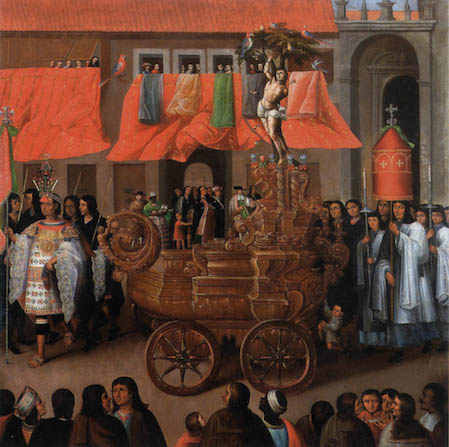
Each of the paintings are named by the main subject of that piece, which made for easy identification. Whether it be a parish, a religious order, or a depiction of a biblical narrative, it was named after the focal point of the painting. A prime example of this is the painting named Parish of San Sebastian. Based on the previous information, I am sure you could guess that the main focus of this specific work is San Sebastian. Saint Sebastian was a soldier in the Roman army and also a martyr. At first, his Christian beliefs were kept secret, so he was able to fight in the army. Once his true identity was revealed, he was sentenced to be executed. Shockingly, Sebastian was able to be nursed back to life by Saint Irene who was the widow of Saint Castulus. Sebastian lived for a little while longer before he decided to condemn the Emperor for the brutality he brought upon Christians. As one would expect, this act led to him being beaten to death. Saint Sebastian was a martyr of the faith, so of course the Spanish Catholics wanted to honor him at the Corpus Christi festival. The center point of the painting is a statue of Saint Sebastian mounted high on a carriage. This carriage was not actually what was used during the festival, but the artists used this as a way to enhance the quality of the paintings. The artists, and the ones who commissioned these works, wanted the paintings to seem as luxurious as possible so they added extravagant items, like the carriage, that were found in Spain to accomplish this. In Spain, they were used in religious processions like this one in Cusco. When looking closely at the painting, it is noticeable that the people and carriage are stagnant to allude to the fact that this was not the method of travel used. In the festival, the floats were carried by many people who held them on their shoulders. Since Saint Sebastian was such a prestigious martyr, he received this important honor of having a spot in the procession and then that was followed with him having a painting specifically dedicated to him.
There are several other aspects of Parish of San Sebastian that are arguably as significant as the statue of Saint Sebastian himself. His statue is representing his martyrdom by being tied to a tree and pierced with arrows. As previously mentioned, the purpose of the Corpus Christi festival was to memorialize the changing of the Eucharist into Christ’s actual blood and body. This piece is the one that depicts the Eucharistic host as it was in the parade. It is the piece that is demonstrating what the entire occasion was dedicated to. Proceeding the carriage holding the statue of Saint Sebastian is the Eucharist host being held by the Bishop in a monstrance. The monstrance is the object that holds the Eucharist when it is being presented in a manner such as this. This painting is showing the sacramental bread on its way to the Church, and there is another piece later in the series that shows its arrival at the Church.
Preceding the carriage is a man of indigenous origin. This is able to be identified due to his attire: a typical Inca tunic and a mascapaycha. These specific items denote that he is not just a member of an indigenous group, but that he is the leader of his group. These leaders are termed caciques, and, in this picture, he is acting as the standard bearer by being the representative for his group. The sun face on the front of the tunic he is wearing is a symbol of Andean nobility. Although he is a leader of the Inca, the Spanish still let people continue in this position if they agreed to execute Spanish laws over their indigenous people. By following the Spaniards laws and participating in this religious festival, the caciques, a position that was only maintained by a select amount after the conquest, were allowed to wear their indigenous garments and still be included in Spanish social order. Along with their laws and daily lives being a mix between indigenous and Spanish, the caciques tunic actually had a mix of both cultures, too. The pattern of the tunic, which encompasses the majority of it, was in relation to the Inca culture, but elements like the lace sleeves are from the Spanish. Just from this one clothing item of this one man, you can get a glimpse of ways that the two cultures blended. In addition to the tunic, the crown that the cacique is wearing is a sign of status. It is called a mascapaycha due to the red fringe hanging below it to establish that he is Inca royalty. The crown has intricate features that are used to exhibit he is a pre-Hispanic noble. Some of these characteristics are the silver globe and banners that sit on top of a rainbow and the two curiquingue birds. These birds were considered sacred to the Inca. As mentioned, the mascapaycha was a sign of nobility and this was due to the caciques using them to show who they were descendants of. In turn, this solidified their significance in society. This crown is significant because it is showing both Inca heritage and loyalty to the Spanish state simultaneously. These paintings in the Corpus Christi series, specifically Parish of San Sebastian, are a great depiction of how the Spanish did not completely wipeout the Inca, but instead formed a new culture from the blending of these two civilizations.
The last aspect of this painting of Saint Sebastian that needs to be pointed out is the placement of the people. This is a prime example of the importance of the positions of each type of person in society in the artworks. The class most populated in the community was typically the middle and lower classes, so there are many more of them to disperse throughout the pieces. In Parish of San Sebastian, the ones involved in the procession are the people who belong to the middle class of society. In the actual Corpus Christi festival, they would be the ones carrying the floats down the processional path. Since there are fewer elite members in society than any other class, there are also the least amount of them painted into this scene. Of course, they would not be doing any laborious work for this festival, so they are the ones sitting on the balconies and watching from windows at the top of the painting. The heads at the very bottom of the painting are the people who have the lowest status in society. They are just observers of the procession and do not have a significant status at all. By seeing this one painting, you can see the detail about social hierarchy that was put into both the artworks and into society itself, which is not nearly as defined in our world today.
It is important to go visit the Archbishop’s Palace for not only the importance it has in the Catholic religion, but also for the religious art museum that it is home to. There are countless pieces held there that show the immaculate work produced at the Cusco School of Art in the 16th century that cannot be seen elsewhere. The art that came from here is top notch due to the influences of both indigenous and Spanish culture on it. Also, the building itself is historically significant due to it originally being an Inca palace. Just by walking around the exterior walls, you can see the famous 12 angled stone that the Inca created. Since the Spanish did not completely destroy this structure, there are many Inca elements still present. To continue on the art route, this place contains most of the paintings from one of the most well-known series of this time: The Corpus Christi series. Getting to observe these massive paintings in person would be quite the show. The details of each figure would be so complex and easily identifiable. Most importantly, each of the 12 paintings that are kept here depict such a critical part of the Corpus Christi festival, which is still heavily celebrated in Peru today. These give insight into how important this procession was to the Spanish because they actually commissioned paintings of this stature to commemorate it.
 Indigenous Ways in Peru: Postcards from Students