by Sadie Beeman
When people first learned I was studying abroad in Peru, their initial response would be, “Wow! So you’re going to Machu Picchu, right?” My answer would be the expected yes, with their next thought nearly always being, “So what is your class about?” My response to this question nearly always caught them off-guard. “Our course is called Indigenous Ways in Peru. We’re going to look at indigenous culture in Peru in the past and present, but my specific focus is cranial deformation.” Cue the wide eyes and loss for words. I was astounded at how many people felt uncomfortable with the topic and questioned my choice. I set out to discover why in Western culture we are so off put by the practice and find why the practice remains important today. Cranial deformation may appear to be a mere snippet in the long history of Peru and Latin America, but it maintains relevance through its motives and remains a valuable insight into indigenous culture. Cranial deformation and its remnants reflect the methodology of humanity’s desire to cultivate a sense of identity. Travelers tend to focus on the bucket list sites and cities, yet I believe that by taking the time to understand cranial deformation, the history surrounding said sites becomes clear.
The history of cranial deformation in Peru and other surrounding regions dates back over 10,000 years to around 8000 BC. The resulting head shapes were not uniform which suggests that there were different types of cranial modification. However, each permanent deformation method would typically last until the child reached approximately three years old. It is not concretely known whether each type of cranial modification had a distinct meaning, but researchers have come up with numerous plausible theories. One suggests that the differing techniques were associated with an individual’s ayllu (Hoshower, 161). An ayllu was a kinship unit in Andean society. Therefore, a certain head shape could serve as an obvious symbol of group affiliation. There is little evidence suggesting that gender played a role in the decision; cranial deformation appears to have been a common practice in raising children regardless of their gender (Torres-Rouff, 333). This introduces the idea that parents were responsible for creating a permanent somatic identity for their children. Head shape was an irreversible attribute, and the shape (or lack thereof) that parents chose would follow the children for the entirety of their life. It is similar to the concept of a name; it is intrinsically tied to your identity, yet you have no input in its decision. Another possible motive in cranial deformation could be making a claim to be superior within the population. For example, non-elite parents could give their child a head shape connected to a more amiable societal group, therefore allowing their child to gain significant benefits. In the Tiwanaku population, multiple types of cranial deformation were found which suggests another theory in which head shape was based on class distinction. With the aid of ceramic paintings, it has also been assumed that individuals with no deformation belonged to the priestly class.
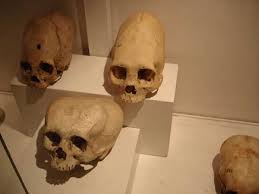
There are a few populations where researchers have determined the exact type of cranial deformation used. The Colla wound tight fitting wool caps onto infants’ heads to mold them into a distinct circumferentially long shape (Hoshower, 147). Alternatively, the Palta had a long skull that was flat in both the front and back. This shape was achieved by pressing the child’s skull with two boards and tightening them until effect was sufficient (Hoshower, 147). Cranial deformation also tended to vary based on geographic location. Along the coastal region, a truncated pyramid appearance was common, whereas a circumferential deformation was common in the Altiplano (Hoshower, 148).
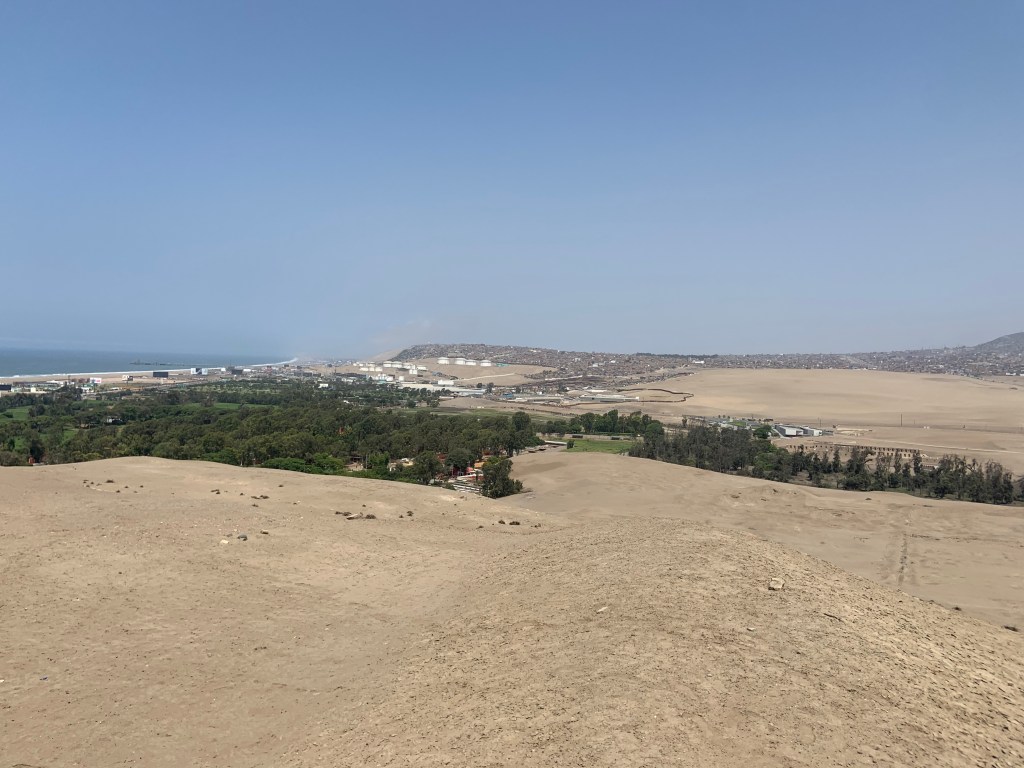
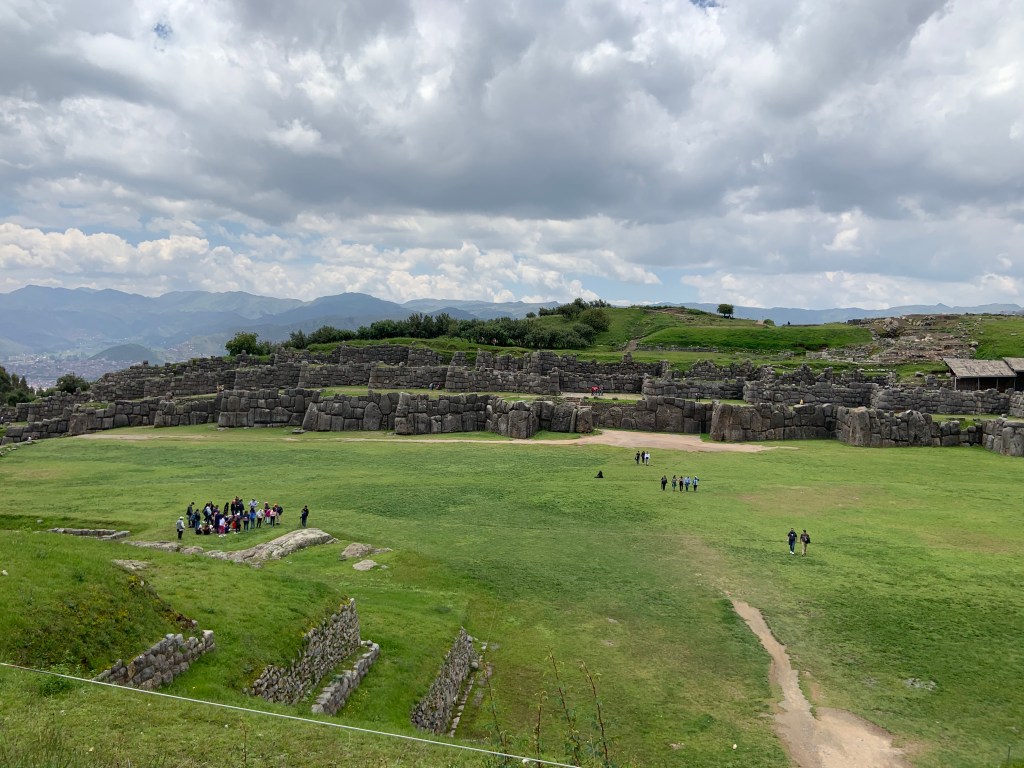
Some discrepancies in head shape among a discovered population could be attributed to migration of groups, creating multi-ethnic regions. In a recently excavated tomb, there were eleven distinct types of deforming apparatuses found and fourteen related types of cranial deformation occurring within the population. These various types of cranial modification imply that significant migration has been a consistent theme throughout the empires of Peru. After visiting sites like Pachacamac and Sacsayhuaman, it is easier to understand why the Inca and other civilizations would make such strenuous pilgrimages. The dominance the sites hold over the surrounding environment is remarkable. In the case of Pachacamac, the Temple of the Sun is housed at the highest point of the site with a breathtaking view of the Pacific in one direction and the rolling sand dunes in the other. In the past, Andean peoples would come for ceremonies and rituals; still today travelers and indigenous groups alike come to pay their respects in their own ways. Sacsayhuaman served a similar purpose as a site for gathering. It’s huge central plaza space was surrounded by massive terrace walls. The site naturally beckons you in and to this day it feeds the imagination as to the ceremonies that occurred there. As we come to understand the appeal these sites had, it becomes clearer why different cranial modifications are found scattered about Peru. Societies were not stagnant or isolated; they were dynamic.
During our time in Peru, there was evidence that migration and pilgrimage still occur today, although under slightly different pretenses. Our flight from Lima to Puno on New Year’s Day was far from full, yet the groups of travelers were diverse. There were elderly couples dressed in traditional clothing, young people in Western clothes, a band, and our group. Although I am only making an assumption, I feel that each of these individuals had a purpose in their journey. Perhaps the old couple had traveled to the city to share traditions of the past with their grandchildren in hopes that they continue on. Maybe the band felt restricted by cultural norms in Puno and wanted to catch their big break in Lima. Regardless of their purpose, their motions mimic those of the indigenous groups that inhabited the land before them. Another instance of pilgrimage I witnessed was when we visited the church at Chinchero in the Sacred Valley. As we stood outside the main entrance, individuals exited the church in procession. The first few individuals to exit were dressed in traditional clothing with the occasional child wearing a t-shirt with a cartoon character on it. When the church had emptied out, the people did not leave the site with their families. Instead, they gathered into large groups which appeared to be based on community. One group included all the people in traditional dress, while another was made up solely of men and women in Western clothing. Seeing these people come to a semi-remote location for Mass provided a tangible example as to what the migrations of the past could have been like.
Cranial deformation continues to be misunderstood today due to society’s predisposition to view the practice as barbaric. Evidence proves that cranial modifications do not induce pain due to the juvenile skull’s plasticity. In an infant skull, the cranial bones are separated and joined together only by strong elastic tissues called sutures forming fontanelles, more commonly known as “soft spots.” The timing of the closing of these fontanelles coincides with the duration of cranial modification. Even today, babies are subject to cranial modification, yet we view it through a lens of necessity. Many babies are given helmets to wear in order to shape their heads into what we consider a natural shape. They can be born with deformities stemming from genetic abnormalities, or parents and doctors can request the helmet to match the natural aesthetic for a baby born with a misshapen or flat head. The practice of shaping a child’s head with cloth and wood might seem foreign today, but our own practices mirror this tradition. In both cases, the parent is choosing to alter the natural shape of his child’s head in order to increase its future happiness. Another misconception society holds about cranial deformations is that they negatively impacted brain activity. Scientists have gathered that these modifications would have few to no detrimental side effects on the shape of the brain. It is more important that the brain volume remains the same. Some may remain skeptical even still, but our largest proof still remains. Successions of ancient Andean societies practiced cranial deformation and went on to build massive successful civilizations. This alone suffices to display that cranial deformation did not create an incompetency issue.
Even today, similar practices continue. For example, neck elongation occurs within small tribes in both Southeast Asia and Africa. This process occurs through the gradual addition of rings to the necks of women, serving as a symbol of wealth and status. The rings create an illusion of elongation; in reality, the collarbones are being pushed down. This practice parallels cranial deformation in the sense that it is a method for an outward expression of identity. It creates a permanent identification method. Another body modification practice which occurred in China was foot binding. The feet of young girls were bound to create a period of trauma and enforced discipline. This practice was originally assumed to be a marriage rite, but recent studies have attributed the practice to creating a lack of mobility in women therefore relegating them to spinning cotton and weaving (Blake, 699). Unlike cranial deformation and neck elongation, this practice was a punishment which sought to instill fear over enhancing freedoms. This is an important distinction to make in order to better understand the motivations behind cranial deformation.
In Western culture, conspiracy theories thrive in the imaginations of travelers. Television programs like “Ancient Aliens” appear to be laughable, but they plant seeds that cause us to view artifacts with a skewed sense of skepticism. On numerous occasions, the show has suggested the sites like Machu Picchu and the Nazca lines were only feasible due to extraterrestrial intervention. Even further, these pseudoscientists have used deformed skulls as evidence to their claims. It is important for travelers to educate themselves on the impacts these types of claims have on history and the way it is interpreted. If we allow cranial deformation to be dismissed as an alien, the practice and its history are implied to be inhumane. I even found myself indulging in the “what-ifs” from time to time, like “what if these terraces were a giant staircase?” Whenever we approach indigenous sites and practices in this way, we are desensitizing ourselves. Our reactions of allure and intrigue are degraded.
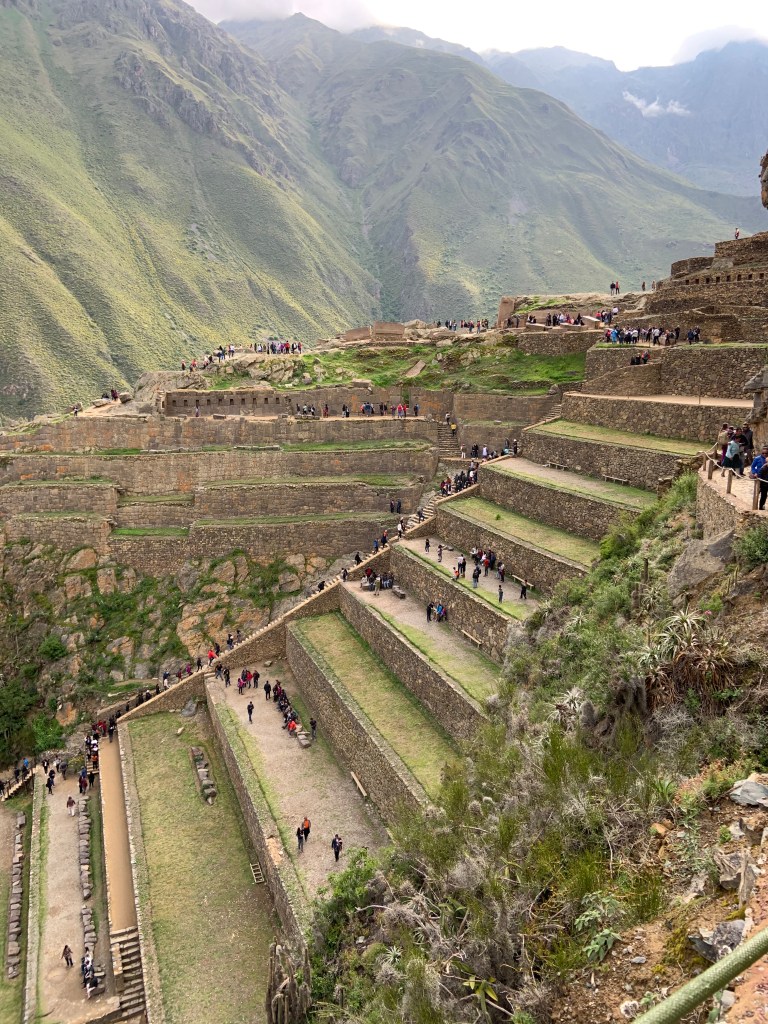
The concept of cranial deformation seems to the modern tourist to be something that should be left in the past and is no longer relevant to the current state of Peru. I would beg to differ and would even argue that the motivations that drove the popularity of cranial deformation still exist today. Upon our arrival in Peru, I was nervous that I would not be able to find a trace of cranial deformation apart from the few skulls housed in the Museo Inka. My only chance encounter occurred in Lima at the Catacombs of San Francisco Church. Skulls were arranged neatly in both stacks and circles. Yet one out of the hundreds stuck out like a sore thumb; in one of the deep pits, an elongated skull completed the ring. Because it was the only one I saw, it caused me to wonder if its placement was coincidental or deliberate. I then realized I needed to focus on the abstract ideas that cranial deformation represented.
One pattern I noticed in Peru was the stylistic choices of the people. Younger men and women appeared to typically dress in Western clothing with modern hairstyles. This group made up the majority of Peruvians I encountered. However, there remained a substantial number of men and women who dressed in culturally traditional clothing and hairstyles. In particular, the hats they wore appeared to suggest more than a fashion statement; wearing a hat seemed to serve as a form of self-expression.
Additionally, no two hats stuck out to me as identical. Some were squatty and made of felt while others stood tall with a brim and appeared to be made of straw. The hats drew my eye in a way that is difficult to describe. When I saw individuals in traditional dress, I felt as if I could assume their indigenous heritage, yet their hats added a depth and individuality that was intangible for tourists like myself. I feel the hats allow a unique layer of expression that remains distinctly their own. Along this line of thought, I am reminded of the use of cranial deformation. While I doubt that the hats are a direct replication of this practice, I do believe that they serve a similar purpose. The head was a symbolic representation of power in ancient Andean societies; for example, trophy heads were common (Verano, 59).
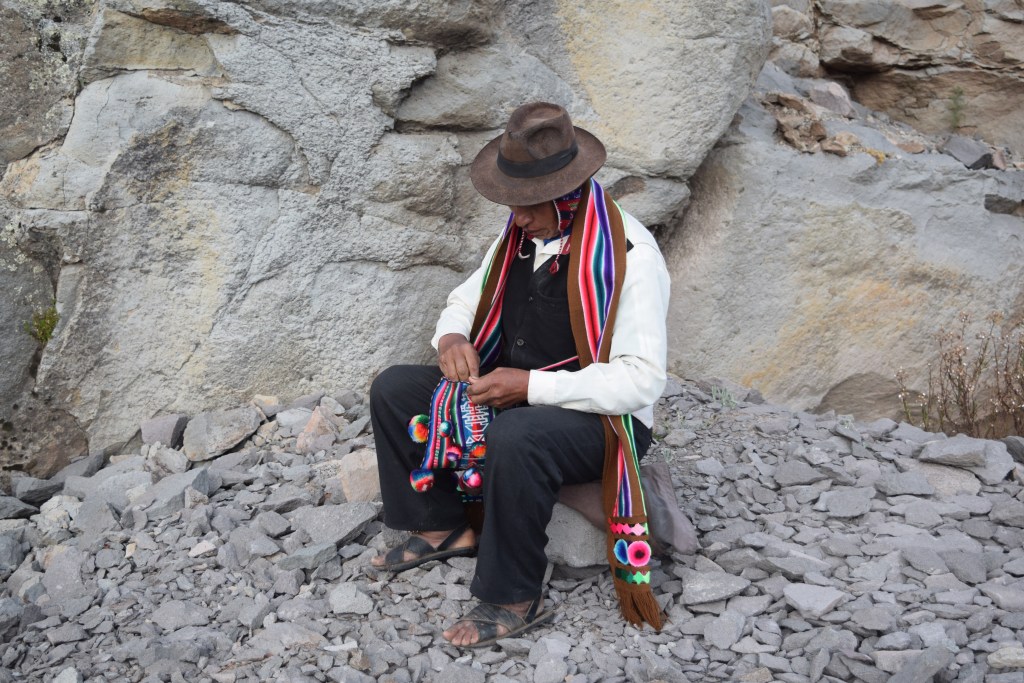
The industry of tourism invites us to dabble into this practice through the hats sold in gift shops and on the streets that mimic traditional chullos. On the island of Taquile, a family presented their courtship rituals to us which included both the practices and the attire. The chullo changed in accordance to the stage of life the individual was in; pom poms were added to indicate relationship status and more. When our group asked if we were able to buy a chullo, our guide Lut spoke with the family who dismissed our inquiry as if the answer were obvious. In the mind of the family, the line between the sacred and the commercial is distinct, but to the consumer minded tourist, the line is blurred. In the Western mind, it would appear that because the family in essence had sold to us an experience with their culture that the selling of chullos would follow.
There appeared to be different spheres that indigenous individuals existed in: the commercial and private. At times, these individuals would market themselves as a commodity, whether it be dressing to imitate an Incan warrior or in traditional dress to pose with a llama. In the same way, many individuals profited off providing an experience. Our first encounter with this was the lunch show at Dpaso. Rather than focusing on providing a culturally educating performance, the dancers create an unforgettable memory. They incorporate the audience; they pull at your emotions.
The commercial and private spheres merged and coexisted during our time spent with our host family on Amantani. As soon as I stepped onto the island, I felt I was being immersed. The family greeted us with immense gratitude and hospitality; they made it feel like we were the ones to be thanked. Our guide Lut referred to them being as close to him as family, therefore they were treating us with that extension. To this family on Amantani, our payment was not meant to be transactional. It was meant to be a reciprocal relationship where our investment was repaid in full through our experience.
When we first arrived at the family’s home, our lunch was being prepared by the older couple and a young woman named Beatrice. I was intrigued to learn Beatrice’s story. As a young woman, she made the choice to move to Lima, yet the city was not for her. She preferred her previous way of life; although tourists may consider it outdated, it provides the pinnacle in quality of life for Beatrice. I feel that as travelers, we attempt to label these attempts as “escaping tradition,” but this could not be further from the truth. We point out obvious differences between the older and younger generations and attempt to label them as a distinct divide without context. Culture does not live and die in a single generation; identity is fluid and is being molded without deliberate thought.
In Peru and other Western cultures, practices similar to cranial deformation are accepted as the norm. We don’t give a second thought to plastic surgery, piercings, or tattoos, yet they are all permanent body modifications. Each of these practices is a way to express and project a certain self-image. Cranial deformation is so much more than an alteration in skull shape. It is the creation of a permanent somatic identity. The practices of cranial deformation and other artificial body modifications are equivalent to our modern methods of displaying our status by the clothes we wear, the cars we drive, and our material goods. The identity of both individuals and societies in Peru continue to evolve. The integration of traditions and ideals from the past and present continue to shape the future.
Works Cited
Blake, C. Fred. “Foot-Binding in Neo-Confucian China and the Appropriation of Female Labor.” Signs, vol. 19, no. 3, 1994, pp. 676–712. JSTOR, http://www.jstor.org/stable/3174774.
Hoshower, Lisa M., et al. “Artificial Cranial Deformation at the Omo M10 Site: A Tiwanaku Complex from the Moquegua Valley, Peru.” Latin American Antiquity, vol. 6, no. 2, 1995, pp. 145–164. JSTOR, http://www.jstor.org/stable/972149.
Torres-Rouff, Christina. “The Influence of Tiwanaku on Life in the Chilean Atacama: Mortuary and Bodily Perspectives.” American Anthropologist, vol. 110, no. 3, 2008, pp. 325–337. JSTOR, http://www.jstor.org/stable/27564015.
Verano, John W., et al. “Modified Human Skulls from the Urban Sector of the Pyramids of Moche, Northern Peru.” Latin American Antiquity, vol. 10, no. 1, 1999, pp. 59–70. JSTOR, http://www.jstor.org/stable/972211.
 Indigenous Ways in Peru: Postcards from Students