Over the last two weeks, I had the opportunity to study abroad in Peru. Through the Honor’s college, at the University of Arkansas, created a class about the indigenous ways in Peru. Now what do they mean by indigenous ways? Something I learned from my professors on this trip is you always need to define what you’re talking about, so how should we define indigenous ways. The way I would define it is traditional and original to the area brought together by common culture. I know that is a broad definition, but I want to make sure that it can encompass many different dimensions. Throughout Peru, there are massive amounts of history regarding indigenous people and their culture. From the alluring scenery in Lake Titicaca all the way to Chiciayo and Piura the history within people’s stories and experiences are priceless.
The one place I had the privilege to study and do research on is Ollantaytambo, located in the in province of Urubamba. Before I start I have to tell you how breathtakingly beautiful this site it. Pictures do not do it justice. It is mainly known to be an archeological site, but it’s also a town in southern Peru approximately 45 miles northwest of Cusco. It is located 9,160 feet above sea level. This elevation is actually higher than that of Machu Picchu’s elevation of 8,000 feet.
Currently, it is called the Sacred Valley of the Incas. The valley stretches from Pisac to Ollantayambo and it includes Machu Picchu. It’s one of the major tourist destination in Peru, which brings over 1 million tourists to the area. The town itself is located along to rivers the Patakancha river and Urubamba river. This will be more important later in the post.
Now why is this site important? Well, before we get into that let me give you some history of the site! First let’s break down the word. Ollantay was a famous Inka captain. He’s known for expanding the Inka’s northern and southern boundaries. However, he’s more famously known for his love story in which he falls in love and had an affair with Pachacutci’s daughter, Cusi Coyller. Ollantay asked Pachacuti’s for his daughter’s hand in marriage, but since he came from lower class Pachacutci declined Ollantay request. Because of their love he got thrown in prison and Cusi gave birth to their child. There was another account that I read stated that Ollantay broke out of prison to fight Pachacutci and ran away with Cusi. However, there is no confirmation that this is the truth. The second part of the word comes from tampu which means the “city that offers accommodation, food, and comfort for travelers”. More historical information of this site include that, Ollantaytambo was the royal estate of Emperor Pachacuti. He was the 9th Inka ruler, and it known for the conquest the Cusco valley and more. Also he’s accredited for founding Machu Picchu, which is a symbol of Peru’s modern day tourism. One of his titles was “earth-shaker”, which people believes that is an appropriate title for him because he led the Incas to be one of the largest empires in the Americas. Clearly, he left such a lasting effect on modern day Peru. Most people know Pachacutci’s legacy because of Machu Picchu. However, one of the most important sites he built was Ollantaytambo, which is impactful back then and in present day. At first, it was his own personal estate from 1438-1471. Pachacuti lived here, worked here, and died here. In Inka culture, the new emperor or ruler would never live in the same buildings of the previous emperor. They either would add on another building or creating a new estate. Furthermore, no other emperor lived in his estate. It was actually turned over it his family and used for administrative spaces. Over the years, Ollantaytambo turned in being a temporary capital for the Manco Inka during the Spanish conquest of Peru.
Now, we fast forward a hundred years to 1536. The Spanish have been in Peru for a few years, and they have been in conflict with the Inka. In 1536 specifically, the Manco Inka defeat the Spanish at Ollantaytambo! From this point onward Ollantaytambo became a symbol of Incan resistance, even though the victory was short lived. After the victory they retreated to Vilcabamba, which is known to be the Lost City of the Incas. Fun fact number two, when Hiram Bingham, the person who discovered Machu Picchu, was rumored to be looking for Vilcabamba when he accidentally discovered Machu Picchu. That’s probably why people believed Machu Picchu held more significance than it actually did. What a fun little connection! Anyways back to the sixteenth century and to the Inka defeating the Spanish. Even with the Spanish having more advanced technology and help from marginalized groups, by the Inka, you would think they would’ve had the upper hand. Nevertheless, the Inka defeated them with slingshots and archers. Which shows their determination and perseverance while defending their land. That’s pretty incredible! They also had other secret weapons that helped them defeat the Spanish, which include their location and geography. The Inka are known to be very meticulous when building their sites. Ollantaytambo is located in the valley perfectly in between Machu Picchu and Cusco. This the only point where you can get to Machu Picchu for travelers. Well there is another “local way”, known as the Inka trail that starts in Ollantaytambo. As I said earlier, it’s located by the Patakancha and Urubamba rivers, which is a great natural defense line. The physical site itself provided a large number of defense properties as well. The terraces are an example of one of them. Think about it, these terraces are huge and trying to climb up and even flight on them would be extremely challenging. Imagine the Spanish coming through the valley on their horses. Then they come across Ollantaytambo and try to attack the fortress. At the same time, there are arrows and rocks flying everywhere scaring the horses and eventually the Inka win the battle. Instead of trying to match the Spanish, the Inka’s used the landscape and geography to their advantage, which lead to a short lived victory. Now you have a small glimpse of why this site is so important to the Inka during the 15th and 16th century.
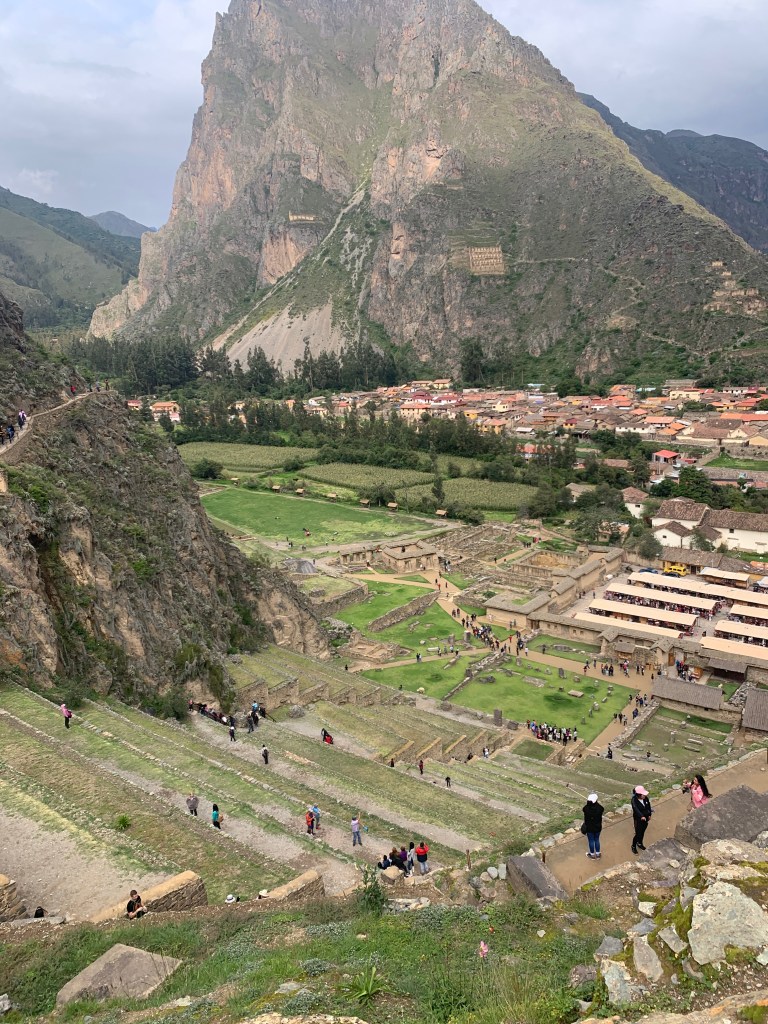
The site itself can be broken up into 4 main sectors. The most prominent feature is Temple Hill, otherwise known as the fortress. However, only a small portion was used for military purposes. The main use was for religious reasons. It is said that is hill looks like a llama. Honestly, I didn’t see it at all. You will find that most local tour guides will say that mountains, lakes, and buildings resemble pumas or llamas. If you ever go, please let me know if you see the llama. On temple hill, there is the Templo del Sol, which actually means temple to worship the sun. The sun is the second most important god the Inka worshipped, and at most Inka sites there is a templo del Sol. The temple itself is incomplete, and there is evidence that they were building this after Pachacutci died. This appears unusual because normally you wouldn’t add on to these estates after the death of builder. This suggests that Ollantaytambo was more than a royal estate.
The next sector of this estate are the terraces. Now, as stated earlier the terraces were used as a mode of defense. However, that’s not it’s primary purpose. The main purpose was for agriculture. You are able to grow certain crops in climates were you weren’t able to do so in these climates. These terraces are some of the largest and steepest out of all the Inka sites. By creating these terraces, they would soak up the solar radiation during the day and release the rays at night creating microclimates better suited for growing corn, potatoes and other plants. The Inka people mastered building terraces not only for farming but to prevent their city form sliding way due to the excessive rainfall in the region. They also like the aesthetic of the terraces.
Another sector would be the quarries, which is known as the Pinkuylluna at Ollantaytambo. These are storehouses located across from Temple Hill. They were built at high altitudes, where more wind and lower temperatures would occur which protected the commodities from perishing. A special feature called qullquas, a ventilation system, was created to supplement this effect. Specifically, the Inka used the original terrain to maximize the effect. They used the upside of the hill to pour grain into the windows and emptied them out of downhill windows. The main purpose for these sites was to store food. It’s important to show that you can provide substance to the people living there because why would you support a leader that can’t provide the basic needs of the people. That’s what Ollantaytambo did, provide food and safety for the people.
The last sector is the town itself. It was built on an orthogonal layout with a central plaza in the middle. The plaza when built is expected to be as big as four blocks. Apparently, the east side was open, and it was surrounded by other buildings and halls on the remaining three sides. The blocks on the southern half of town was built to the same design while buildings on the north were more varied. Ollantaytambo has some of the oldest continuously occupied dwellings in South America. I hope this gives you a better visual of the layout of Ollantaytambo. I remember researching this place and it was hard to put together without physically being at the site.
Innovation is defined as a “new method, idea, or product”. Innovation revolutionizes our world, and throughout history major events are marked by significant innovations. The Inka’s are known throughout the world as magnificent engineers. One of the main features of Ollantaytambo is the Incamisana temple. This translates to water temple. Water is a key element for the Inka. Their design of water systems was influenced by their strong beliefs in the power of water. It’s known to be the center of cosmology, religion, and agriculture. The engineering of this place is remarkable. Historians and Anthologist used reverse engineering to analyze the effects of this technology. They concluded that the application of law of physics, engineering principles, and basic knowledge of science were applied in building these systems. The majority of people that built this were natives from the area, especially Cusco. However, there is evidence that there were works all the way from the Lake Titicaca region. It’s important note that is technology wasn’t invented by the Inka. It had been developed by earlier Andean civilizations over many years. All started by the Wari and Tiwanaku people. Traditionally this knowledge was passed down orally, so it’s somewhat of a mystery of how it all got started. Furthermore, they did all of this without a written language. This is extremely different from western culture were we write everything down to have some kind of evidence of who built it. However, the Inka didn’t invent these things like a water system, roads, and terraces. The foundation was laid down by the Wari and Tiwanaku people, but the Inka just capitalized and enhanced those technologies. When the cotton gin was it wasn’t necessarily a new invention but it was an innovation. That technology impacted the world, and that’s why I find innovation extremely powerful for societies.
Now, think about physically trying to build this technology. The engineers really had to be created. However, the Inka are excellent at using their environment and that’s what the engineers used to their advantage. They used the mountainside of the valley because it was the perfect place of gravity water supply development, and they used underground water conduits to channel water. Through this mechanics we still have flowing water today. For an example, the Bath of Princess is still running today and its symbol of their knowledge, power, and religious significance. This fountain is to be said to be the most significant ancient fountain in all of Peru. Now where did they supply the water for this temple and fountains. Well there are two sources of water the Inka’s used. The first came from Lake Yanacacha, which brought water to Temple Hill. Then the other source was the Rio Pumaphaqcha, which had pre-existing canal routes that was supposed to reach the eight terraces. However, this canal was never fully completed.
This water source and canal brought a source of life to these temples to give people a place to worship and offering. This is a piece of evidence that demonstrates that the Inka were invested in their religious beliefs, and Ollantaytambo is an example of the ritual control of water. Since it’s located between two rivers it uses its location to show the supernatural and real power of this site. Controlling water was made possible by forcing water in the hydraulic works of the Inka. It demonstrates the absolute power of the Inka and right to rule.
Now let’s take a step back and talk about their religious beliefs. The Viracocha is considered the creator. He made humans on an island in Lake Titicaca, and taught them how to “live and assigned them tribal dress and customs”. According to legion he traveled through the land he created and handed over his creation to “lesser gods” to take care of “human affairs”. Then there is the Inti, which is the second most important behind Viracocha. He is the sun god. The Inka referred to themselves as Intip Churin which translates to children of the sun. They believed that they were on a mission from the sun to “conquest”. That’s was the sun had a temple at most locations the Inka were located. The most important temple for the sun is the Coricancha located in Cusco. The next god is Illapa which is the thunder god that controlled the weather. They would pray for rain to sustain them on agriculture. Then we have Pachamama, she was considered to be the mother earth goddess. She was the god of fertility and the protector. I could go on and on, but there is one more that is important to the site of Ollantaytambo. The god, Mamacocha, is the Lady Sea. The Inka believed that the sea was the source of all water, and the Pacific Ocean is a goddess. Then the streams and springs were daughters of the sea. That’s just an overview of Incan beliefs, which explains why certain elements were influential to them.
As you can see that Ollantayambo is more than a royal estate. It is considered to be a stronghold of the Inka and one of the most important historical sites for the Inka. We have seen how the Inka defeated the Spanish, brought in elements of the sun and water, they shaped the earth in the way they wanted to. We have seen how it was important in the 15th century to Emperor Pachacuti, and during the 16th when they defeated the Spanish. However, why is it important today? Why does an old Inka site impact people today? Well, it’s a place where we can understand Peru’s history. You can’t understand a place without knowing where it has been. That’s why we need to know about Ollantaytambo. It gives a better insight to the Inka’s. Like I said earlier they don’t have a written account’s, so the next best thing is physical site. Also you can see how all Inka sites interconnect. Ollantaytambo is the starting point for Machu Picchu, every site has a temple del sol, and there are similar architecture styles in all Inka sites. As you can see that even though the purpose has changed but it changes and adapts with the times. Just like people and culture.
My personal experience at Ollantaytambo was amazing. It was one of my favorite places we visited while in Peru. I would take into account that my point of view maybe a little skewed. Furthermore, I wasn’t expecting Ollantaytambo to be set up the way it was. It’s hard to imagine what is going to be like through written accounts and pictures. When we were driving up the narrow stone path to get to the town part of Ollantaytambo, I wasn’t expecting it to be on a little plateau. Then throughout the city you can see the old foundation of the water canals, and you have a plaza in the center of town. It quite cute. However, it’s very westernized with tons of restaurants, shops, and hostels. Especially Italian restaurants. Then you walk up to the actually structure, and it’s huge and steep. I seriously wasn’t expecting it to be that steep. It was like a 90-degree angle. Let me tell you climbing up that hill wasn’t easy but since there were so many people at the site it gave me a break while climbing. That’s another thing, Ollantaytambo was extremely busy. Like I haven’t seen any other site in Peru be that crowded. For some reason I wasn’t anticipating it to be that crowded. In my head I believed people only wanted to see Machu Picchu. On the other hand, I didn’t realize this is the stopping point that headed to Machu Picchu, so it makes sense that people would stop by and see this site. Here are my tips if you ever end up going to Ollantaytambo. I would do you research or join a touring group. I know that doesn’t sound appealing, but there aren’t a lot of signs explaining what everything means. Having someone tell you some of the history and layout would be extremely beneficial. I would also bring your tennis shoes and layers of clothing. Your experience won’t be enjoyable if you aren’t dressed properly. Lastly, keep an open mind and question everything. That’s the process of truly learning and having an authentic experience. I hope you enjoyed this post, and next week I will be talking about the effects of tourism!
 Indigenous Ways in Peru: Postcards from Students