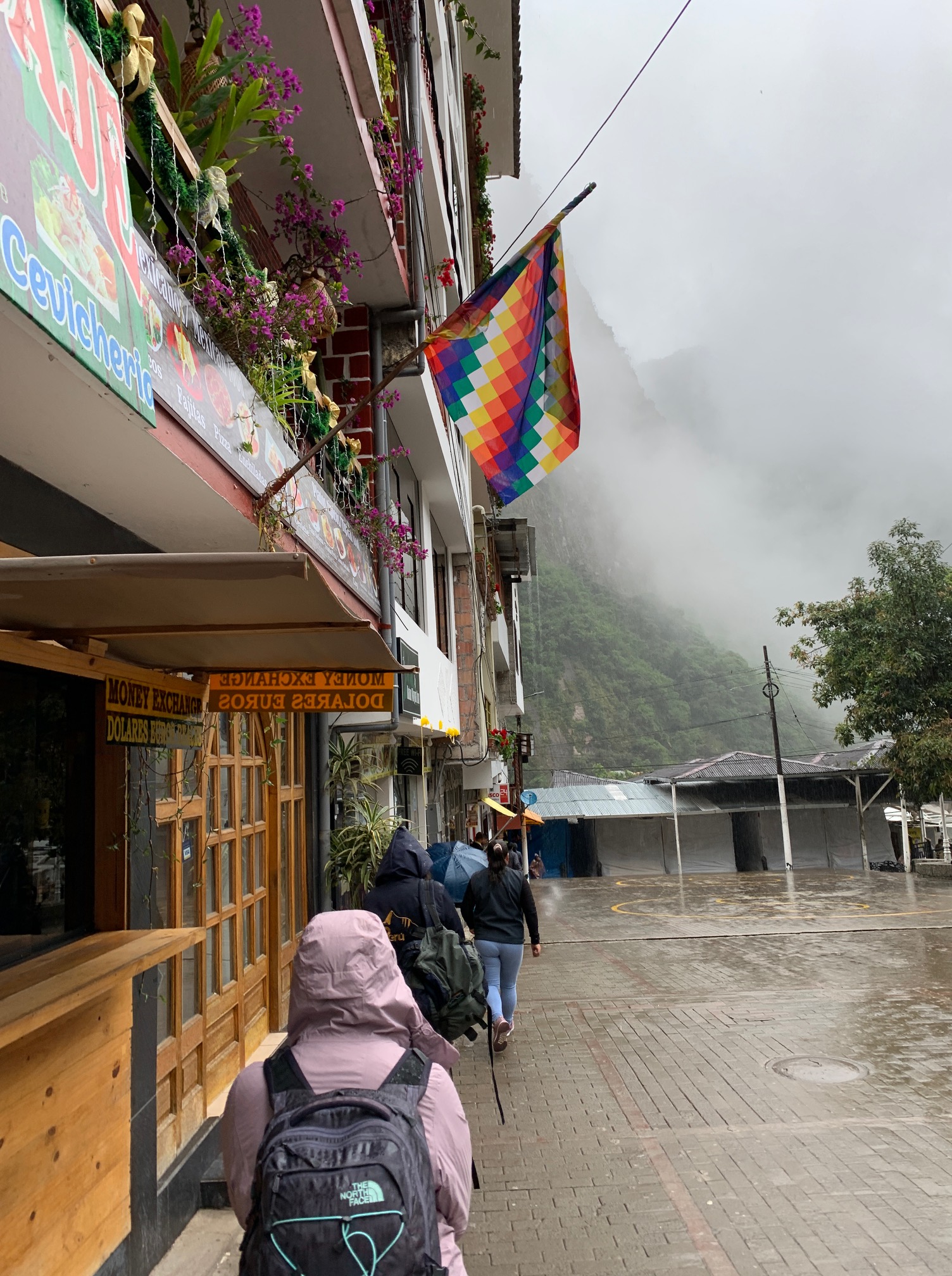
It can be easy for tourists to parachute in without context to a place and simply absorb at face value what they are told by their guides and the locals around them. Indeed, this is what some guides count on, because, like all other people, guides have their own opinions that shape how they see things, and they wish to impart that worldview onto others. I do believe, though, that when we fail to pick up on the context of a society, and the realities of the spaces that these historical sites are now placed in, we miss a far more interesting picture of a country’s history. The Incan past can often be exaggerated by those telling it, but where they exaggerate is part of the story, and very often in the places where they seem to be bending the truth, they might be revealing a deeper sentiment in Peruvian society. It can be very easy for (white) Westerners to assume that Indigeneity is incompatible with modernity, that the Inca were a people that existed solely in the past and with no connection to the present. That narrative, of course, is problematic. For one thing, the Quechua and Aymara are still very much around, and on the second point, they are still very much involved in modern power dynamics.
The topic I chose to write my report about was the recent events in Bolivia, because this country best exemplifies how Indigeneity still factors into politics. To set the scene, Evo Morales, the president of Bolivia until very recently, when he was ousted in a military coup and replaced by the right-wing leader of the Senate, was the first Indigenous president in Bolivian history. (New York Times) This, of course, was a big deal in a country that was majority Indigenous, and his tenure represented not just the symbolic gain of having one of their own in power, but also many concrete policy gains from the Morales administration. (The Guardian) The country saw robust economic growth and dramatic reductions in poverty. However, some Bolivians were itching for someone new, since he had been in power since 2005, and for many young people it was hard to imagine the President being anyone else other than Morales. (America’s Quarterly) The election of 2019 was fraught by its very existence: a referendum in 2016 had said that Morales had reached his term limit and could not seek re-election. However, a tribunal, seen as stacked with people sympathetic to Morales, said that it was basic human right to stand in election and therefore could not place term limits on him. Perhaps because of this, there was a chance that Morales would not be re-elected. In Bolivia, in order to be elected on the first round of voting, a candidate must either get an outright majority, or 40% of the vote plus a 10% lead over all other competitors. (New York Times) It was widely seen that if Morales failed to win in the first-round, he would lose in the run-off to his nearest opponent, Carlos Mesa. All eyes were on the election. Then, as the votes were being counted, the election administration went dark. When they came back online, Morales had enough votes to win on the first round but a thin margin. The opposition cried foul. What happened next was utter chaos. Violent demonstrations with dozens of deaths took place in the aftermath, and a military coup ousted Morales, who was then replaced with the right-wing Jeanine Añez. Añez is of European descent, and has said things that mark her as hostile to Indigenous interests. She has referred to Indigenous rites as “Satanic”, and once tweeted a caricature of Morales that labeled him as a “pobre indio”, a racist attack. (New York Times) After her installation as president, some police forces were reported to have removed the Whipala, an official Bolivian flag and the representation of Bolivia’s diverse Indigenous groups from their uniforms. Many Indigenous groups saw these as signs that the gains they had made under Morales could soon be reversed.
This matters because Morales’ election was the culmination of decades of Indigenous organizing. Indigenous organizing had been a centuries-long tradition, as groups banded together against Spanish rule (though it should be noted that at first, there was no pan-Indigenous identity, and such an identity was only formed after centuries of Spanish oppression). The 1930s and 40s marked the beginning of modern Indigenous organizing, with the formation of the Confederación Sindical Única de Trabajadores Campesinos de Bolivia (Postero, 27) though at first Indigenous people did not organize along their identity, but along their identity as “campesinos” or peasants. This was because Indigenous identity was heavily stigmatized, so being seen as a class rather than a race was a step up for them. (Postero, 28) The Indigenizing of the movement would take place later, in the 1970s, with the Katarista movement, named after Túpac Katari, an 18th century resistor to Spanish colonial rule. (Postero, 28) The Katarista movement fused Indigenous and class identity, as a pueblo, and especially in Bolivia, this identity would form the basis of its political developments. As neoliberalism came to be the dominant economic and political ideology, political reforms created a greater space for political expression, while economic reforms led to inequality that hurt Indigenous people, leading to a greater chance of protest. Indigenous thinkers began to question the legitimacy of the Spanish colonial states, as well as question the legitimacy of other Western ideas and structures. (Postero, 29) The neoliberal reforms also weakened unions, the traditional vector of leftist organizing, so it was up to Indigenous organizing models, such as the ayllu, to fill the void. (Postero, 31) Morales came into power because of Indigenous organizing. The event that propelled MAS into government was the 2003 Gas War, where Indigenous peoples protested the gas extraction policies of the previous administration, and formed a political crisis acute enough to justify new elections. (Postero, 31) Once Morales was in power, he drew very consciously on Indigenous political organizing history, such as holding a 2015 rally in front of a representation of Tupac Katari. (Postero, 37) The Katarista movement formed the ideological underpinnings of Morales’ own party, the Movimiento al Socialismo, or MAS. Or rather, it formed one part of the party, because the party was a sometimes tenuous coalition between Indigenous leftists, which saw the world through the lens of an intersectional race-class identity of Indigeneity, and more run-of-the-mill leftists who hewed more towards Marxist, class-based identity. Indigenous leftists were more likely to want to see the state decentralized, and focus on sustainable development, whereas other leftists wanted a centralized, industrialized state. (Postero, 34-39) But the coalition held, until recently. But, if Morales’ tenure was successful for a great deal of people, and perhaps led to a rising middle-class, why did that middle-class not want to vote for another Morales term? This is perhaps a sign of one of the weaknesses of the race-class identity; as people no longer saw themselves as poor, they also did not identity with the Indigenous label as strongly as in the past. There has been a marked decline in the number of Bolivians self-identifying as Indigenous, and this was Morales’ base. There is still a sizeable portion of Bolivia that sees themselves as Indigenous, to be sure, but it is not enough to put Morales over the top. The young, college-going middle-class is seeing itself “Westernize”, and there is a tension between the younger generation and the older ones who still see themselves as Indigenous. (New York Times)
But why does this matter to a tourist in Peru? The same debates and divisions that have taken place in Bolivia are often mirrored in Peru as well. There are some key differences between Peru and Bolivia, to be sure. On one hand, Peru does not have nearly as many Indigenous people as Bolivia does (though it is still at 20-30%), (Cleary, 59-60) so it is a lot harder for Indigenous people to take power. Organizing in Peru is still done mostly along class lines still, but there is definitely a sense of Indigenous identity. During our tour of Machu Picchu, our particular guide was explaining an aspect of the Incan empire, before launching into a polemic about how the Lima region (the capital region, defined by a rising middle class with a taste for American culture) was parasitic and the Cusco region (where the guide lived, and much poorer than Lima with a greater proportion of Indigenous people) was the area with all of the resources and historical sites and therefore could sustain itself. It is important to note that the split is somewhat cultural, but overwhelmingly it is political. Indigenous people will still use iPhones and drink Coca-Cola products, so it is not that Indigenous people are “rejecting modernity”, which is demonstrably false and is also a trope that tends to be used to justify the erasure of Indigenous culture and identity, because if Indigenous people really did reject modernity, then they have to be swept aside for the inevitable march of “progress.” And indeed, in the States, very similar rhetoric was used to justify expulsion of our Indigenous people. We often conflate Westernization and modernization, and this conflation is problematic. The issues that Indigenous people take to the changes occurring in their countries is often centered around the environmental degradation that has taken place at the hands of international corporations (framed as attacks against Pachamama, or Mother Earth in Quechua), and the economic inequality that has been caused by neoliberal policies.
This internal debate can be best seen in the discussion by Indigenous thinkers around the ideas of decolonization. One idea of decolonization is the decolonization of politics, and focuses around the idea of Indigenous people taking back control and self-determination. (Postero, 12-13) Another strain of decolonization sees the process as inherently violent, and in the process, a new, decolonized subject would be formed, that is separate from the pre-colonial Indigenous identity. The third strain of decolonization focuses around the decolonization of thought, and that Indigenous peoples should imagine a political future for themselves outside of Western ideas of the relationship between people and government. Modernity is not in conflict with Indigeneity, and the discussion within Indigenous movements about how to approach the current state of the world is one that is very nuanced.
From this model of a formation of a Indigenous political consciousness, comes the question of how to interpret the history of South America.. History is often not just fascinating in its own right, but also fascinating in how the society grapples with and interprets its own past (or for that matter, what a society considers to be its own past). In Peru, for example, the dominant motif is the Inca. Many brands invoke the Inca in some way, and there is even a soft drink named after the Inca. While a lot of this could be chalked up to indulging the tourists’ visions of Inca glory, there are far more serious political themes undergirding these associations. As mentioned before, during our tour of Machu Picchu, our guide brought up how he perceived the Cusco region to have everything it needed to be self-sustaining, whereas the Lima region got its wealth by taking from the rest of Peru. Another one of our guides said that the reason why the Inca were able to complete the Machu Picchu quickly was because the workers on the project were “happy” (spoiler alert: it was forced labor and the Inca had no problem breaking up communities to quash dissent). But again, the reason why Indigenous guides cast the past in this way is because they are making an argument in the present, and for a tourist in Peru, there is a lot more to be gained out of not simply accepting things at face value but trying to pick at who is telling the story of Peru’s past, how that affects the story being told, and if there is some other story being told underneath the surface.The existence of the Inca for Indigenous people, since they are descendants of the Inca, is invoked not merely as a point of historical pride, but as an argument for self-determination outside of the colonial power structures that have oppressed Indigenous people in modern Peru. The leftist thinker Hugo Blanco contrasted the Inca against the neoliberal order, by stating that the Inca, even when they were a little oppressive, focused their efforts on improving the well-being of their subjects, whereas the neoliberal order focuses entirely on the profits of multinational corporations. (Blanco, 162) There is also a critique of the individualism of neoliberalism, contrasted with the tight, collective kinship structures that dominated Inca society, and even an argument for how the Inca were skilled at agronomy. (Blanco, 152-168) Now, this narrative is a little on the problematic side, because, as mentioned before, the Inca were not as benevolent as they are sometimes made out to be by their descendants. As a general historical rule of thumb, rapidly expansive empires owe at least some of their success to being very brutal, and the Inca were not okay in the least bit when their subjects failed to meet their quotas. At the same time, it is important to also understand the context in which these comparisons are taking place, and whether or not they are in service to an oppressed group or an oppressor group, and these seem to be in the service of the former. Not all Indigenous people connect themselves to the Inca, however, so this question is a bit complicated. One other fallacy that shows up in this “Incanismo” is the idea of the originality of the Inca, that they were the first, and perhaps only, culture. The same guide at Machu Picchu that I mentioned earlier presented the Inca as this culture that had existed in some form for thousands of years, and erased the cultures that had come before it, such as the Wari or the Moche. In reality, the Inca were a very recent culture, only being around for about 150 years before the Spanish arrived. The Inca, of course, borrowed from previous cultures, and there is some truth in saying that new cultures aren’t created so much as they are blended together from existing ideas and beliefs, but the Inca were definitely a distinct political organization, and this was papered over in the guide’s presentation.
Understanding the political, social and cultural context of a place is crucial for tourists or students who wish to learn about a place and take its contributions seriously. There is a lot to learn just from the ruins themselves, to be sure, but there is not a point where history ends and the contemporary begins; it is continuous. Therefore, part of understanding the significance of these sites is seeing how they, and the people who built them, connect to the present. Indigenous identity has not remained constant, and the meaning of these places for Indigenous people have not remained constant, and for tourists and students, this story can be learned by the way that Indigenous people present the history of their country, and how that speaks to the current political situation of the day. It is not enough just to look, one must also listen.
Works Cited:
Anatoly Kurmanaev and Clifford Krauss. “Ethnic Rifts in Bolivia Burst into View with Fall of Evo Morales.” The New York Times. November 15, 2019. https://www.nytimes.com/2019/11/15/world/americas/morales-bolivia-Indigenous-racism.html
Edward L. Cleary. Resurgent Voices in Latin America: Indigenous Peoples, Political Mobilization, and Religious Change. (Piscataway, NJ: Rutgers University Press, 2004)
Hugo Blanco. We The Indians: The Indigenous Peoples of Peru and the Struggle for Land. (Exeter: Imprint Digital)
Elizabeth S. Penry. The People Are King: The Making of an Indigenous Andean Politics. (New York: Oxford University Press, 2019)
Juliana Barbassa. “Thanks, But Goodbye, Why Evo Morales’ Former Supporters Want Him Gone” America’s Quarterly. https://www.americasquarterly.org/content/thanks-goodbye-why-evo-morales-former-supporters-want-him-gone
Linda Farthing. “‘Democracy in Bolivia has two faces’: ambivalence as Evo Morales seeks fourth term”. The Guardian. October 17, 2019. https://www.theguardian.com/world/2019/oct/17/bolivia-election-evo-morales-seeks-fourth-term
Nancy Postero. The Indigenous State: Race, Politics, and Performance in Plurinational Bolivia. (Oakland: University of California Press, 2017)
Oliver Balch. “How a Populist President Built Himself a Palace”. The Guardian. March 7, 2019. https://www.theguardian.com/world/2019/mar/07/how-a-populist-president-helped-bolivias-poor-but-built-himself-a-palace
Shane Greene. Customizing Indigeneity: Paths to a Visionary Politics in Peru. (Stanford: Stanford University Press, 2009).
 Indigenous Ways in Peru: Postcards from Students