It is a new year; as a matter of fact, it is a new decade. I know, I will give you some time to let that sink in… Each new year comes with new goals. We have all set aside some new goals for the new year and the new decade. For me, personally, I have set some minor goals, such as working to become a better listener; nothing too crazy or spontaneous. However, I am here to convince my readers to have spontaneous goals, impulsive goals even, that push you out of your comfort zone. There is no better way to start on the right foot for the new decade than traveling to a different continent. It is time to pack your bags and fly to South America; we are going to Peru!
“Why Peru?”, you may ask. Even though there are many astonishing countries in South America that are more technologically advanced or have better coastal lines than Peru, the country still shines. Peru is a unique and captivating country that has very close ties with its indigenous culture. Peru is blessed with many great archeological sites built by the Incas. For example, one of the most famous is Machu Picchu. It is one of the Seven Wonders of the World for its mysterious history and breathtaking views located in the Amazon Rainforest. It is home to many natural wonders like Lake Titicaca, the largest lake in South America. Even though it was freezing cold, I had the opportunity to jump into it, so I did! Look at me being spontaneous! One of the must-see cities in Peru is Cusco. Cusco is filled with cathedrals, plazas, and ruins that are mostly all within walking distance from your hotel. Amongst these attractions is a place dear to my heart that I want to focus on, the marvelous temple called Coricancha.
The Coricancha was an elaborate complex built with the most exquisite Inca masonry and metalworks. Coricancha is a Quechua word that translates to Golden Temple; however, the Spaniards referred to it as the Temple of the Sun1. It was the principal shrine of the Inca Empire, which displayed the wealth of Cuzco and was the focal point for religious rites. It was built in Cusco because of the two rivers that surrounded the city, one of which can be viewed at the top of Machu Picchu. The Coricancha was a series of buildings and courtyards surrounded by large, tall walls. Inside these walls were temples that were dedicated to deities that were embedded with gold and silver at every inch of every building2. The source of the gold and silver that was used in the temples came from the spoils of war. That being said, the Inca has impressive military achievements for the amount of gold the Coricancha was dressed in. The rulers of Inca were ambitious men who would conquer vast territory using alliances. They would offer gifts to the leader of the tribe. If the leader accepted the gift, they would work in harmony. If not, then the Inca would overtake them and force them to subdue. The empire would continue to expand until the conquistadors would dismantle the Incas. To this day, the Inca Empire was the largest empire ever seen in the Americas.
One of the many awe features of the Coricancha was its architecture. The Coricancha was physical evidence that shows the conservative features of Cuzco-style masonry, niche designed, and wall style that is indistinguishable from the other building in Cuzco2. It was a model of a building that combined the functions of royalty, religion, and administration in one. At the Coricancha, you can see the picture-perfect masonry style that has given the strength and stability of the wall to withstand all the earthquakes in the past and hopefully in the future. The masonry had sunken joints, and the walls were battered. Its key feature was the beveling of the edges of the stone that used no mortar3. The Inca masonry was so precise that a knife blade cannot be stuck in between the two edges of the stone. Now, the methods of quarrying the stones are still under study. It is believed the stone was cut by boring holes into it. Then, using wood as wedges, they would be dampened with water to separate the stone into pieces slowly. Men transported the stones because the invention of the wheel has not been created, and there was no large animal capable of pulling the weight. Once the stone was roughly in place, they would use smaller files to acquire the perfectly smooth faces. Unfortunately, when the conquistador came to Cusco, they overtook the city and melted all the gold and silver at the Coricancha. Next, they converted the temple into a catholic church called Santo Domingo1. The Coricancha consisted of multiple buildings and courtyards. These courtyards had large open areas that could hold many people for religious or military gatherings. The courtyard had patios accompanied by fountains; some even were made out of gold. Although the Incas displayed an advanced irrigation system, the water source is unclear. One of the most important and most significant temples at the Coricancha housed the huaca called Punchao (the day)3. This temple had a substantial value because it housed a golden statue that was in the shape of a man. The golden statue represented their sun-god, which had a circular plate of gold enclosed in a halo of rays. When the sun rose, it would hit the golden halo and illuminate the entire room marking the beginning of the day. Another temple housed a silver image of a woman that represented their deity to the moon3.
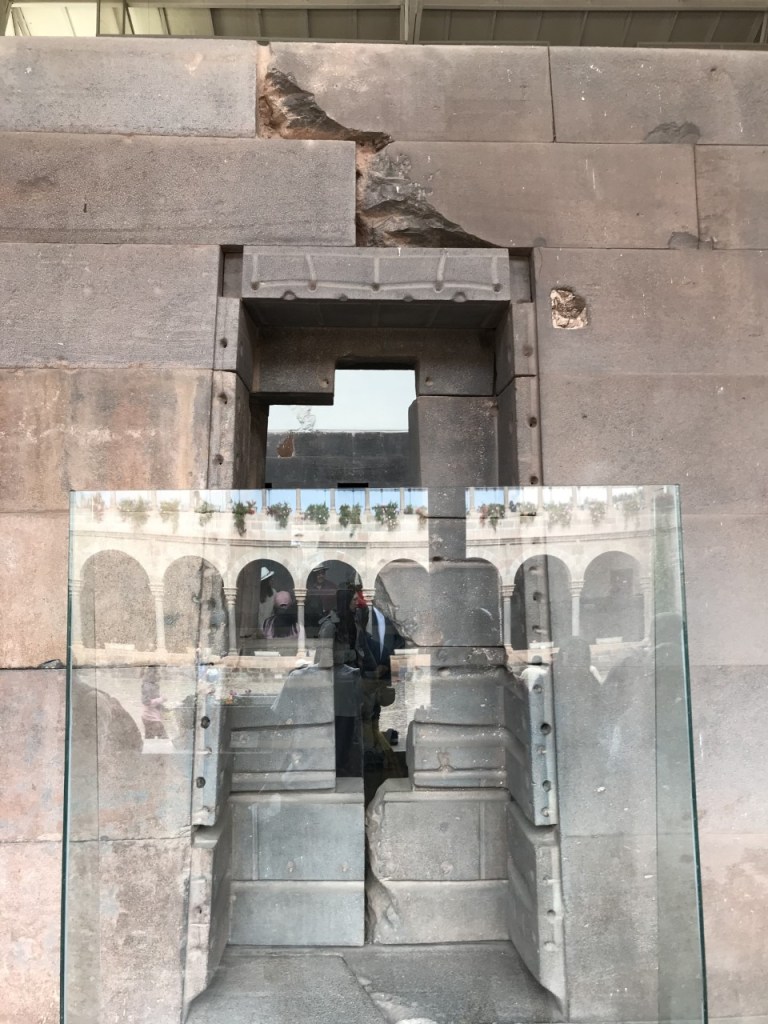
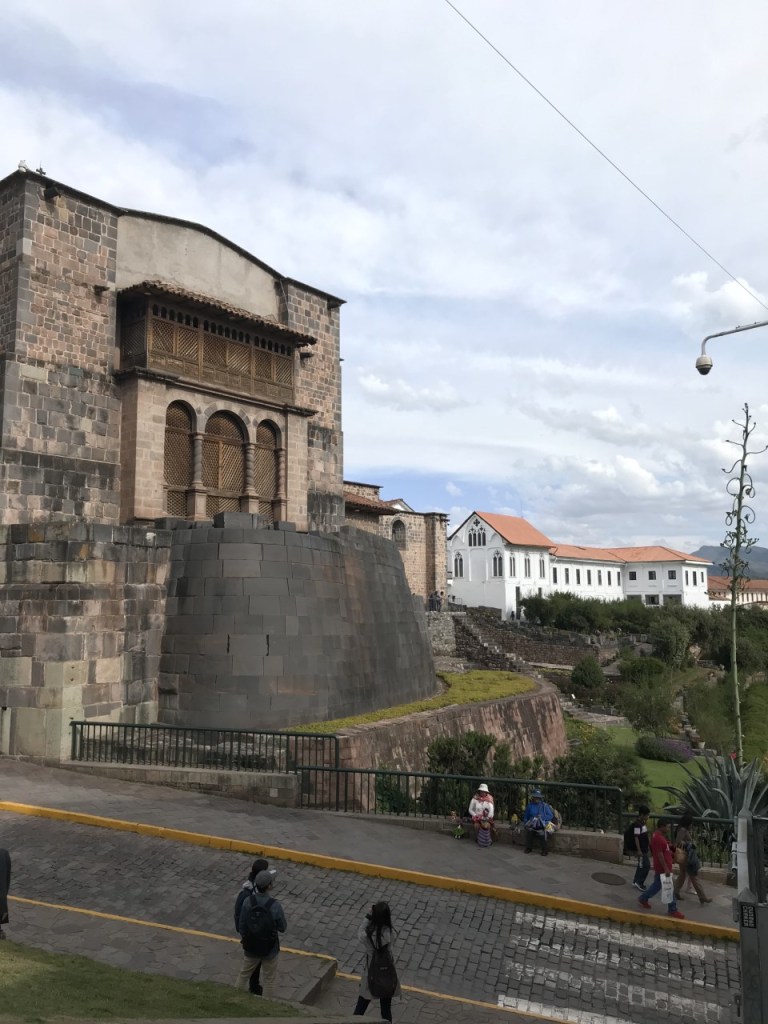
Now, all these details sound remarkable, but seeing in person is a whole new level. As soon as you walk down the street, you are greeted with the famous curved wall of the Coricancha. That wall has stood for 800 years through all of nature’s rain, sun, and earthquakes. The wall is so strong that the conquistadors used it as the foundation to build their church on top of it. Even the Santo Domingo has undergone renovation due to numerous earthquakes. Yes, the Coricancha has multiple personalities, and it can be a confusing building. Currently, the site has three personalities; it is an Inca temple, catholic church, and an art gallery. The stones were all sorts of shape and size; some managed to be as long as three feet or as short as half a foot. In addition to its impressive size, the stones had a large number of angles. Some have up to 27 corners, and if you walk around the city of Cusco, you will come across the famous twelve angle stone. One thing that nearly every stone had in common was its perfect smooth line that made them fit “like a glove” without using any mortar. It is mind puzzling how the Incas were able to pull this off. No wonder the conquistadors believed that they had help from the devil, which is one reason they destroyed the temple. Others think that they were not human but actually Aliens. When you enter the Coricancha, you are greeted by a smaller scale model of the Coricancha in its present-day form as the Church of Santa Domingo. Once you pass that, another jaw-dropping experience begins as you enter into the church plaza. The church plaza is a two-story design with beautiful arches. On the second floor, it has flowers hanging off the patio. Underneath the ceiling of the first floor is where you can find the original ten-foot walls of the Coricancha on the left and right side of the plaza that stretches down the hall. The wall has many windows and doors that one can enter into the rooms that are roughly the size of a nice master bedroom. You will notice that the windows and doors all show the standard Inca trapezoid niche design with symmetrical arrangements. The niches were found with drilled holes that were used to hang gold plated items and gems. If you look carefully on top of the wall, you can see more notches were the Inca would hang gold plated banners. Once you step through the niche doors, inside, one wall has three windows, and the center one is hollow. I went towards the center window and looked up; immediately, I laughed. It was a laugh of disbelief. I could not believe that I was looking through a window that perfectly intersected through two other windows. It did it so well, that when I showed a photo of it to my dad, he thought it was a mirror. He did so because another person was taking a photo from the other direction of the last window, and my dad thought the reflection was me. The symmetrical details at the Coricancha are unbelievable. More importantly, I laughed because this was the east side of the wall. We all know that the sun rises on the east side. Thus, at the right moment of the sunrise, the sun would shine through all of the windows and illuminate the room. Hence the name, Temple of the Sun. I was and still am excited because I was connecting everything I have read on paper into a real-life experience. I wish I were able to be there in the morning to see the sunrise. I highly recommend future travelers to set time aside to experience this phenomenon.
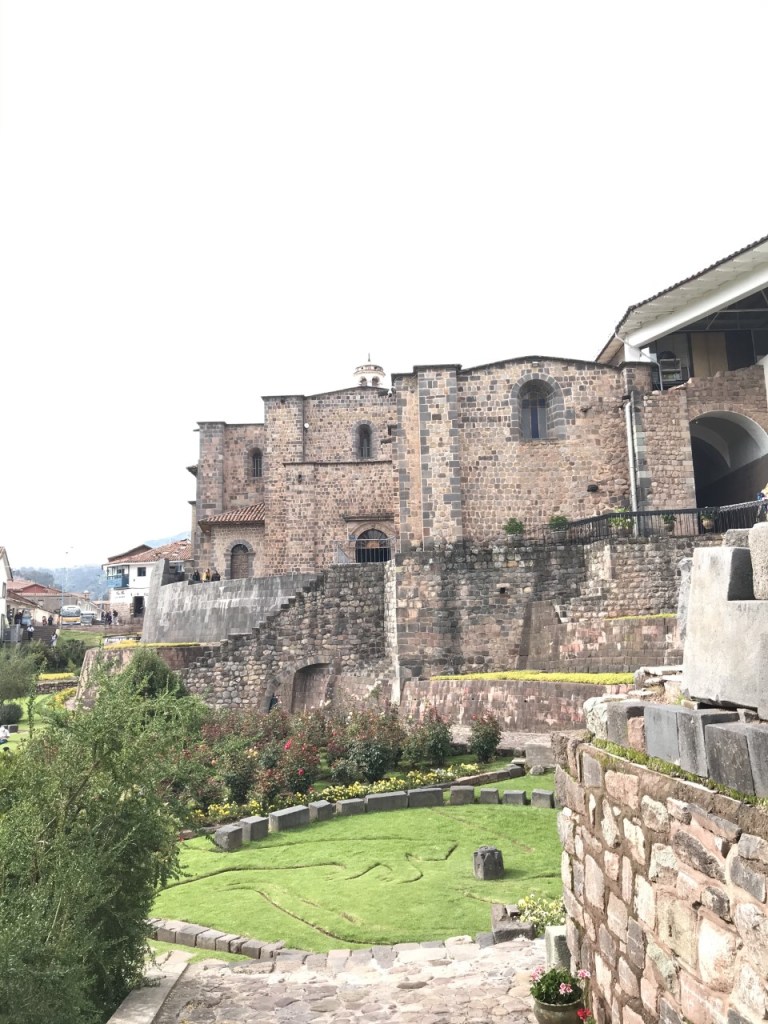
As you continue walking down the same wall, in the last room, you can see a model scale of the thought to be Coricancha in the 1200 AD. It showed the five temples, each with its highly raised thatched roofs that were made out of wood. The temples were dedicated to the main Inca gods. Each temple would have contained large amounts of gold, silver, and gems; some even housed mummified remains. The model also showed a famous garden. It is believed this garden was used more as an offering than the agricultural purpose for that area was found to have gold and silver objects that represented the Inca empire1. For example, gold cornstalks, llamas, birds, and jars. On the right (west) wall, it shows many similarities to the wall on the lift. It has one of the best-preserved niched designed that clearly shows the drilled holes where the gold and gems would be inserted into. When you make your way out to the “backyard,” you come across again the curved wall. From this view, you can see the mixture of the Inca temple with the Spanish church. You can clearly tell the different time periods by looking at the stonework. As stated above, the Inca masonry is one of a kind built mainly out of limestone. In contrast, the Spanish built its church using a cobblestone. The yard had an area that displayed the Inca trilogy, which is the condor, the puma, and the snake4. These three animals represented heaven, earth, and the world of the dead, respectively. As I explore Peru, the Inca trilogy was presented in the crafts and paintings of the Peruvians.
Shifting personalities to the catholic church, there was no Inca wall on the south or north wall. Inside the south wall of the church, there was an art gallery denoting colonial and contemporary artwork from the school of Cusco. There was one artwork that caught my eye. It was this marble statue of Jesus; however, the artist decided to use three pieces of marble. The head, chest, torso, and legs were made from one piece, but the arms were individually carved and attached to his body. I could not figure out why the artist did it. I wonder if it had a meaning to represent the Holy Trinity in Catholicism of the Father, Holy Spirit, and Son or if it was as simple as that the artist did not like his/her work of the arms and restarted them. As I continue exploring the temple/church, there is another room that held liturgical object and clothing of the time. They even display a gigantic mirror if you need to see how you outfit of the day is looking.
Shifting personalities back to the Inca temple, the Coricancha has more to offer than just architecture value. The Coricancha was the focal point for the major religious rites that occurred in the capital city of Cusco. The Inca Empire divided the Cusco Valley into four regions. The Coricancha was at the center of Cusco and the center of the intricate ceque system. The Cusco ceque system is a ritual system composed of several hundred shrines called huacas and ritual lines called ceques5. The indigenous Peruvians define huacas as a sacred object or place for the worship of gods, prayers, and sacrifices. At these huacas, the indigenous Incans would offer coca leaves, guinea pigs, llamas, textiles, and gold items to their gods. In extreme cases, children were sacrificed. Huacas are often located in reserved, unique places such as caves, springs, mountain peaks, and large rocks. There are over 300+ huacas that radiate out from the temple. The ceques were denoted as straight lines that radiated out from the center of the Coricancha. It was seen to be a way of spatial organization that extended back into the pre-Inca times. It formed the four major royal roads. From each of the four main roads, other ceques would branch off arranged in order with the respective huacas and its district as it progressed further out of the city. No ceque contained fewer than three shrines, and some had as many as fifteen. The ceques were more than just a map where huacas could be found. They were also connected to social relationships and divisions of labor5. Furthermore, it seems that the ceques were constructed around cosmology. There are various accounts of huacas on hilltops where monuments were placed where the sun rays would hit it at astronomically significant periods. These monuments were called “sucanca” which are the Inca version of solar pillars. For example, the huaca Chinchincalla was a large hill with two sucanca that when the sun reached them, it meant it was time to plant4. Another example is the two sucanca that were located at the temples of the Coricancha; they would mark the beginning of the December solstice and the June solstice5.
Lastly, there is one other spectacular feature of the Cusco ceque system. By relating the ceque system with cosmology, it created the framework of the Cusco calendar5. Each huaca represents a day, each ceque a week, and a group of three ceques was a month. The huaca counted the days in the clockwise order. The calendar showed the significant periods of the Incaic months, seasons, half-year, and year. The Inca would determine what marked the half-year and year by studying when the June solstice began and finishes after the sunset in April. Thus, the Ceque calendar is a well grounded in archaeological evidence of Inca astronomy and their ritual.
When I made it to the wall that speaks about the Cusco Ceques System, astronomy, and ceque calendar, I couldn’t really make the connection from paper to real life. However, they have many visual aids to help imagine the ceque system at Cusco. I wanted to hop on an airplane and get an aerial view of the city to see if one could still make out the “straight” lines. When it’s not raining or the sun beating on you, I would try to stare up in the sky to see if I could make out the astronomy that the Inca saw. For example, they believed certain stars made an outline of a llama and other essential animals related to the Inca. I, however, was never able to find a llama in the sky, which was upsetting. It is surreal to think about all the technological advancements that the Inca had nearly a thousand years ago. The Incas were indeed an inspiring empire that showed resilience, leadership, and innovation.
I highly recommend everyone to pack their bags and fly to Peru. Peru has a lot to offer, and a visit to the capital city of the Incas is a must. When you are visiting the Coricancha, you are time traveling back in time to one of the most important and sacred temples of the Inca Empire. There is never a dull moment when the building switches its personality; it keeps you excited as a young kid in the candy store. The Coricancha is genuinely a confusing building that embodies so many cultures in one. It is a perfect example of hybridity. One can learn about the Inca time period while also immersing oneself with the colonial time period. The Inca history is endless with the Coricancha, and the stories are also endless. So now, will you accept my challenge for the new year and visit Peru?
1. Bauer BS. Ancient Cuzco: Heartland of the Inca. University of Texas Press; 2004.
2. Niles SA. The Shape of Inca History: Narrative and Architecture in an Andean Empire. Iowa, UNITED STATES: University of Iowa Press; 1999. http://ebookcentral.proquest.com/lib/uark-ebooks/detail.action?docID=837095. Accessed January 19, 2020.
3. Somervill BA. Empire of the Incas. Infobase Publishing; 2009.
4. Zuidema RT. Brian S. Bauer. The sacred landscape of the Inca: the Cusco ceque system. xiv+249 pages, 128 b&w photographs, 27 maps, 8 figures, 10 tables. 1998. Austin (TX): University of Texas Press; 0292-70865-3; hardback; US$50. Antiquity. 2002;76(292):592-593. doi:10.1017/S0003598X00090840
5. Ruggles C, Urton G, Urton G. Skywatching in the Ancient World: New Perspectives in Cultural Astronomy. Boulder, UNITED STATES: University Press of Colorado; 2007. http://ebookcentral.proquest.com/lib/uark-ebooks/detail.action?docID=3039877. Accessed January 19, 2020.
 Indigenous Ways in Peru: Postcards from Students