Introduction
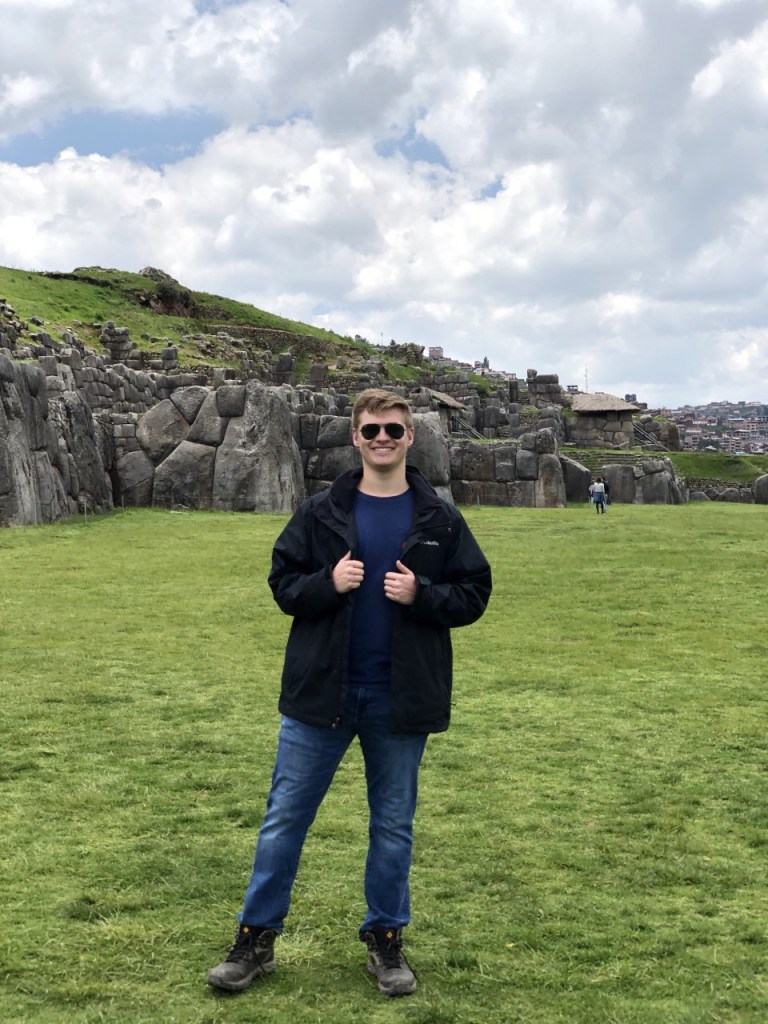
I will never forget the way that I felt when I placed my hands on the wall of Sacsayhuaman for the first time. It is an incredible feeling to do so much research on something and then to travel halfway around the world to see it with my own eyes. Sacsayhuaman is translated from Quechua to mean the “place where the hawk is satiated.” It is a magnificent archaeological site located just above the former Inca capital of Cusco on a hill that is surrounded by mountains. I was born in a small town in Southwest Arkansas known as Hatfield. Its population is just under 400 people and growing up I never would have imagined that I would have the privilege of traveling to Peru to study. If you would have told me that I would be giving a lecture on the top of massive Incan fortress to my peers – I would likely have called you crazy. The University of Arkansas is a place of boundless opportunity and I am so thankful to have been afforded the opportunity to learn and study in Peru.
When I was selecting which site I wanted to research, I felt a connection to the ruins of Sacsayhuaman and the history that follows it. The ruins of Sacsayhuaman sit just a short drive away from the city center of Cusco. Its impressive stature suggests that the complex was a place of military strength. My favorite thing about the country of Peru is how incredibly layered everything is. There is so much to every site that you visit and people that you interact with. For example, when you look at a very Catholic Cathedral in Peru you can see a very western style in it. As you get closer, you start to see Andean influences all throughout the details and you learn that it was constructed by the hands of ingenious people. Sacsayhuaman is just as layered. From the surface, you see a complex guarded by three massive stone walls. The walls are in a zig-zag formation that projects both the power and majesty of a powerful Inca empire. You think to yourself that this is a place that would be the seat of a mighty army. But it is actually so much more than what is on the surface. Sacsayhuaman was a place for worship, ceremony, storage, and so much more. It even became a powerful symbol for the Spanish that represented their conquest of Cusco and the Incan empire.
Layout of Sacsayhuaman
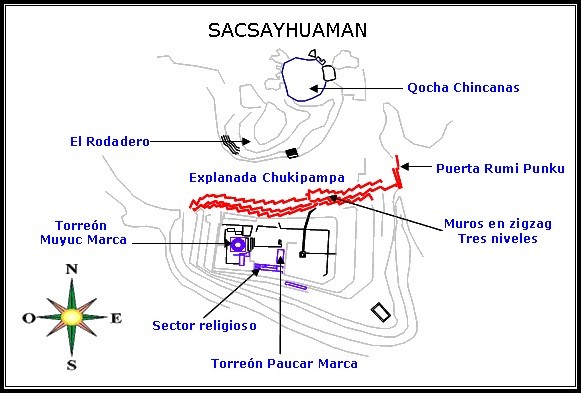
There are four main areas of Sacsayhuaman. I have attached the map above to use as a visual guide to walk you through the ruins. On the day that we visited, we walked up from the north side so that is where I will start. The first notable area is labeled on the map as the “Qocha Chincanas.” It is the large circular area that looks like it might have been an amphitheater and some scholars suggest that’s what it was. The word “Quocha” means lagoon in Quechua and many scholars believe that area was a water reservoir or even a water temple. Just judging off the name of it and from my own perception of the area, I think the latter is more likely. Just north of the Qocha, there are tunnels that lead to throughout the city of Cusco. These tunnels are said to be a labyrinth of pathways that lead to the Sun Temple of the Qorikancha. The tunnels themselves are shrouded in mystery. In his book Jungle Paths and Inca Ruins, Dr. William McGovern wrote “… In this cavern is supposed, and with good reason, to be hidden a large part of the golden treasure of the Inca Emperors which was stored away lest it falls into the hands of the Spaniards. But the cavern is so huge, so complicated, and its passages are so manifold, that its secret has never been discovered.” The government had blocked up the entrance to the labyrinth and probably for good reason. Dr. McGovern then tells a story about a man that was apparently able to use the tunnels to find his way to the Sun Temple and when he emerged he had two gold bars in his hands. Unfortunately, his mind had been affected and he died shortly thereafter. Unfortunately, we did not get to do any spelunking for gold since the cavern was walled up – either to protect us or the secret gold treasure that they are hiding
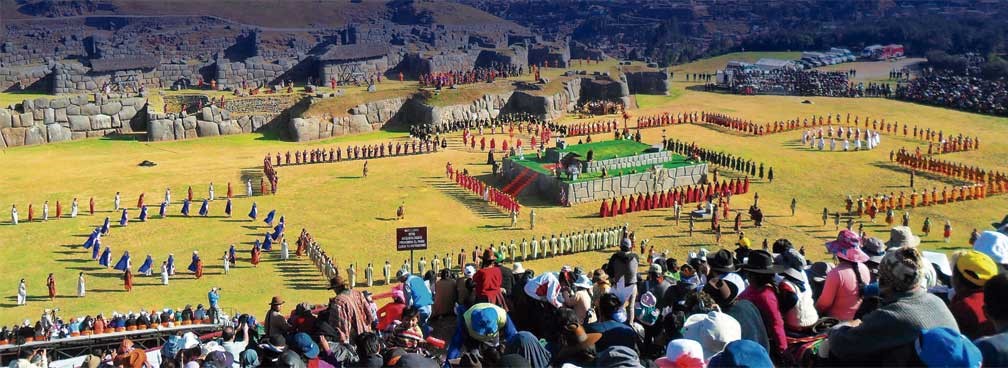
The second area is the lawn area in the middle of Sacsayhuaman which is labeled the “Explanada Chukipampa.” It is a massive open space that people would come in and take part in celebrations such as Inti Raymi. This is a theme throughout major Incan sites and I love the way that it challenges the western ways of thinking about military fortresses. It is a massive fortress that looms over the people of Cusco, but instead of it just being a symbol of power and might, it is also a place where the people are invited into worship and celebrate their Gods. This area is still used today by the people of Peru for massive celebrations.
The third notable area of Sacsayhuaman is the Incan Throne. It is a beautiful succession of seats carved into the rock. It is said that this where the Inca rulers would sit as they were watching the processions on the lawn that sits below it. Dr. Austin made a very interesting point about the way that the throne was sitting. As I said before, it is said that it was a place where an Incan ruler would watch the people on the lawn area right near him. However, the seat itself is not facing the center of the lawn area. The throne is facing the city of Cusco below the area of Sacsayhuaman. The symbolism on this is significant and something that you should not miss. Why would the Inca carve the throne in such a way? I believe it represents a commitment from the Incan nobility to the people of Cusco and the throne is a physical manifestation of that focus. I stood upon this area and could feel the energy from the throne. When you get the opportunity, take a moment to stand on this area and imagine yourself as a legendary Inca ruler looking out on their Kingdom.
The fourth area that I will speak about is the main complex of Sacsayhuaman. The most prominent feature of it is the three massive walls that surround the structures. This is something that you truly have to see to believe. The walls are made up of rocks that are 90-125 tons each. It is almost hard to believe that human hands could even move these rocks into place. Even so, the walls are fit so perfectly together that it would be impossible for someone to stick a pin into it. The walls of Sacsayhuaman are a true testament to the skill of the Inca in matters of Masonry and are a true marvel of our world. When the Spanish first arrived, they couldn’t believe it either and many of them believed that the Inca were aided by the Devil in constructing Sacsayhuaman. There are still plenty of people who think Sacsayhuaman was built by otherworldly forces – including aliens.
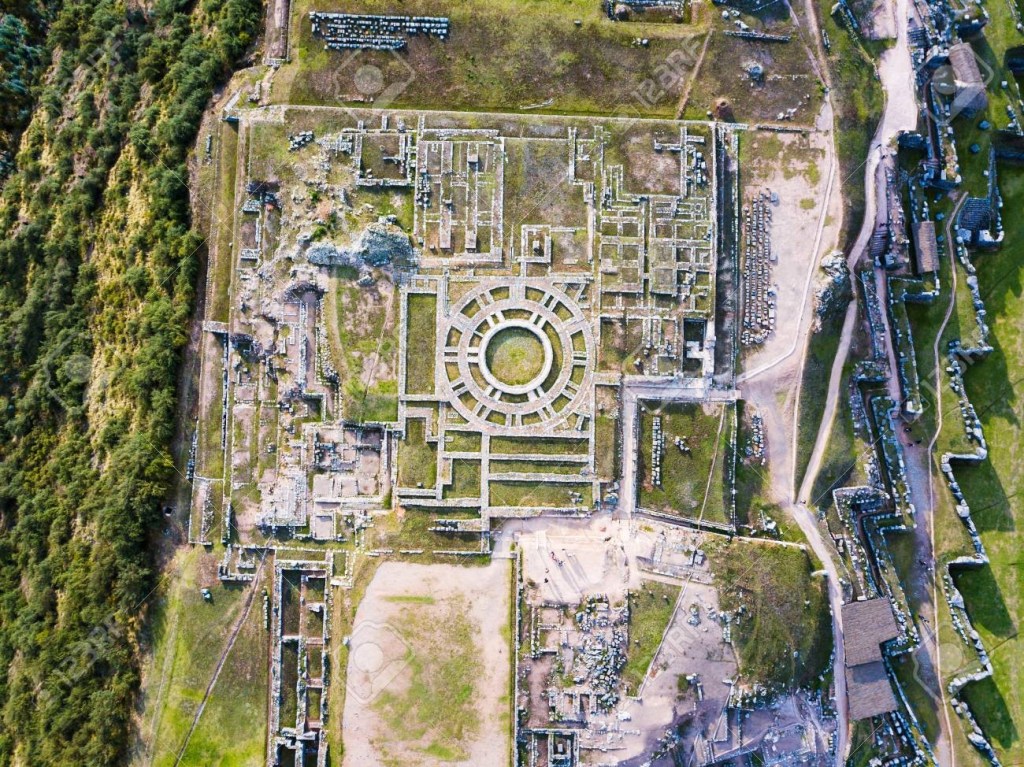
As you can see, all the remains are the foundations of the buildings that used to be there. There were massive towers that loomed over the rest of the fortress. The first tower had a large circular shape Muyumarca which was located in the center, the second was Sayacamarca and could be seen throughout the city of Cusco, and the third was Paucarmaca which was in a square shape. The rest of the complex had buildings that would have been used for storage, worship, and other military functions.
Sacsayhuaman and the Arrival of the Spanish
The Spanish shaped the future of Peru when they arrived in South America. My first thought when researching Sacsayhuamn was about what the Spanish were thinking when they saw the site for the time. Luckily for us, Pedro Pizarro recorded his thoughts when he and his brothers came to Cusco for the first time. He had this to say about the structure:
“…on top of a hill, they [the Inca] had a very strong fort surrounded with masonry walls of stones and having two very high round towers. And in the lower part of this wall there were stones so large and thick that it seemed impossible that human hands could have set them in place…they were so close together, and so well fitted, that the point of a pin could not have been inserted in one of the joints. The whole fortress was built up in terraces and flat spaces.” The numerous rooms were “filled with arms, lances, arrows, darts, clubs, bucklers, and large oblong shields…there were many morions…there were also…certain stretchers in which the Lords traveled, as in litters.”
This is a wonderful account of Sacsayhuaman during the prime of its use. I think it is important to note that the idea of Sacsayhuaman being a fortress was put into existence by the Spanish as they painted in western light. A complex surrounded by massive walls in the western world is a military fortress. However, as we know, Sacsayhuaman is so much more but nonetheless, the military functionality of it was what stuck. This is largely also due to it being a major strategic point during the Siege of Cusco that took place during the Manco Inca Rebellion (1535-1544).
The Manco Inca Rebellion
Manco Inca was one of the last lords of the Inca Empire. After Atahualpa was captured at Cajamarca and later killed, Manco Inca was selected by the Spanish to the next ruler of the Inca. Originally, Manco Inca was thrilled to be the new leader. Shortly after his ascent to power, he began to grow tired of the Spanish and being the puppet empire. The Spaniards proved to be extremely greedy and demanding of Manco. They ultimately had little to no respect for him or the other Incan people. Manco’s power was confined to traditional ceremonial and religious duties while the Spanish forced him to give up locations filled with precious gold and silver. Eventually, Manco rebelled and took refuge in the Yucay Valley. He began amassing a massive army. Incan warriors from all corners of Peru flocked to his call and to fight back against the Spanish invaders. In 1536, the Inca were ready to take the Spanish into battle. Manco led an army of 100,000, sources vary on the amount, to attack the city of Cusco and reclaim the former Incan capital. They attempted to take the Spanish by surprise in Cusco and they were able to occupy much for the city and they were able to take control of Sacsayhuaman – a crucially important piece of holding Cusco. The siege of Cusco lasted for months. The Spanish attempted to send help but the Manco made sure all messengers were intercepted. They were vastly outnumbered and faced a mounting threat each and every day. The Spanish knew that if they wanted to have a chance of winning this battle – they would need to retake Sacsayhuaman.
Juan Pizzaro developed a plan to lead a Spanish Cavalary under the cover of night to retake the Incan stronghold. The men were experienced in climbing the walls of castles and were equipped with a series of ropes and ladders. They assaulted the fortress and were able to quickly scale the walls of Sacsayhuaman. The battle was intense but the Spanish offensive was ultimately successful. Juan Pizarro ended up dying as a result of this battle but they were able to take control of Sacsayhuaman. This gave the Spaniards much needed relief on the garrison located in Cusco. They were able to use this victory to propel their forces forward in the conflict. Ultimately, the Inca were defeated and the Spanish rule over Peru was officially established at this point in time.
Following the Siege of Cusco
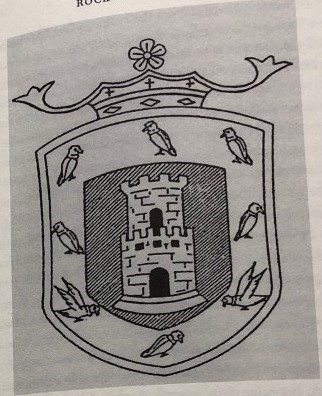
In the year 1540, a grant of Arms was awarded to Cusco by King Charles V. It features a castle of gold on a field of red. The castle represents Sacsayhuaman, the fortress conquered by the might of the Spanish Empire. The tower is surrounded by eight condors who had gathered for the dead of died in the fighting. This is a clear representation of the battle between the Spanish and Inca at Sacsayhuaman. It served a number of different purposes for the Spanish. At the time, it could be said that Sacsayhuaman was very much a signature of the Incan people. The Spanish turned this powerful Incan site into a physical reminder of their conquest.
The Spanish, unfortunately, did not stop there and worked to make a more physical reminder. As they were beginning to build “Spanish Cusco,” they used Sacsayhuaman as a source of stone. Each of the new buildings built by the Spanish was essentially built by removing one from Sacsayhuaman. Bit by bit and within a few years, they pretty much destroyed the buildings block by block. The only thing that reminds today is the foundations of the complex and the stones that were too big for the Spanish to move. They were unable to do anything with the walls. Fortunately for us, the massive walls of Sacsayhuaman are still with us today and are truly works of art.
Some of the Spaniards weren’t really on board for the destruction of Sacsayhuaman and expressed that discontent. Garcilaos de la Vega, a son of a Spanish conquistador and an Inca noblewoman, was a chronicler who suggested that the stone was convenient but it was also a source of envy for the Spanish. The destruction of the site represented conquest, but it also seems to be the result of envy and pride.
Modern Usage of Sacsayhuaman
Every year on June 24th, the people of Cusco celebrate Inti Raymi, the Festival of the Sun. Inti means Sun and Rami means celebration in Quechua. It is a celebration of God Sun which was the principle God of the Incan religion., It is said that the Pachactutec created Inti Raymi to celebrate the Winter Solstice. It is a massive gathering of people and a large part of the tradition for the people of Peru. Our favorite chronicler, Garcilaos de la Vega, recorded a lot of what is known about the Inti Raymi celebrations put on by the Incan empire. According to Garcilaos, the celebration would last nine consecutive days taking part in various locations all over Cusco. On the main day (June 24th), chicha would be drank, music played, music danced to, and sacrifices were made. In 1572, the Viceroy Francisco De Toledo banned the celebration altogether after the series of Inca rebellions that took place in the 16th century. In 1944, the people of Cusco used the writing of Garcilaos to reconstruct the celebration of Inti Raymi. Each year, the festival has grown in prominence and is one of the largest events that happens in modern Peru. People from all around the world travel to Sacsayhuaman to celebrate the sun and give thanks for his generosity. Below is a picture of a modern celebration of Inti Raymi in the lawn area outside of Sacsayhuaman:
Closing
I just covered a ton of history about Sacsayhuaman. I did so because I wanted you to understand the depth of this place. I chose this location because it was described as a fortress to me and I thought that the history behind it would make for interesting research. What I discovered in my studies was so much more deep. Sacsayhuaman is a marvel of humanity and should be considered one of the greatest construction projects completed by human hands. The walls of Sacsayhuaman are breathtaking and tell a story of a civilization whose mastery of masonry leaves us wondering how they were able to pull it off. Even so, the significance of this place extends so much further than the walls we see. Sacsayhuaman was the site where thousands used to gather and where thousands continue to gather today. It is a place that held such strategic importance that the fate of a rebellion was decided within its walls. It is a place that represents a connection between the people and the God Sun. I love Sacsayhuaman because of the way that it challenges western thinking. Where a western fortress represents power and strength, Sacsayhuaman represents community, religion, tradition, and much more while also displaying the power of the Incan people.
As I was preparing to give my lecture to the class, I was very intentional about how we entered the site. We started on the northside near the Qoucha, passed the Incan throne, went into the lawn, and then entered the very center of the walls of the fortress as we climbed to the center of the structure. The first question I asked my class was “What did you feel as you went through the walls?” Their answers were wide-ranging and showcased the true beauty of Sacsayhuaman. They talked about the impressiveness of the walls, the power the structure projected, the vast lawn area that sat before it, and much more. It seemed to me that everyone had a different feeling put off by the structure. That type of experience is truly one of a kind and I believe that it represents why Sacsayhuaman is so magnificent – it’s layered in rich content.
If you are visiting Peru, Sacsayhuaman should be considered an absolute must for your visit. Perhaps you can take a place of an Incan ruler and look out from the Inca throne, maybe you can stand next to Muyumarca and feel the energy from the God Sun, and maybe you can dance to the tune of Incan instruments at the celebration of Inti Raymi. As I think back on our voyage to Peru, Sacsayhuaman was easily a highlight from my trip and I am already excited about the prospect of seeing it again one day.
Sources:
Dean, C. (2010). A culture of stone: Inka perspectives on rock. Durham, NC: Duke University Press.
Cartwright, M. (2020). Sacsayhuaman. Retrieved from https://www.ancient.eu/Sacsayhuaman/
Hemming, John (1970). The Conquest of the Inca London: Pan Books.
Inti Raymi 2020 – Festival of the Sun Tickets – Festival del Sol en Cusco. (2020). Retrieved from https://www.intiraymi.pe/
Kerrigan, M. (2017). Battle of Cuzco. Retrieved from https://www.britannica.com/event/Battle-of-Cuzco
McGovern, W. M. (1928). Jungle paths and Inca ruins the record of en expedition. London: Hutchinson.
Prescott, W. H. (2011). History of the conquest of Peru: with a preliminary view of the civilization of the Incas. Lawrence, Kan.: Digireads.com Pub.
 Indigenous Ways in Peru: Postcards from Students