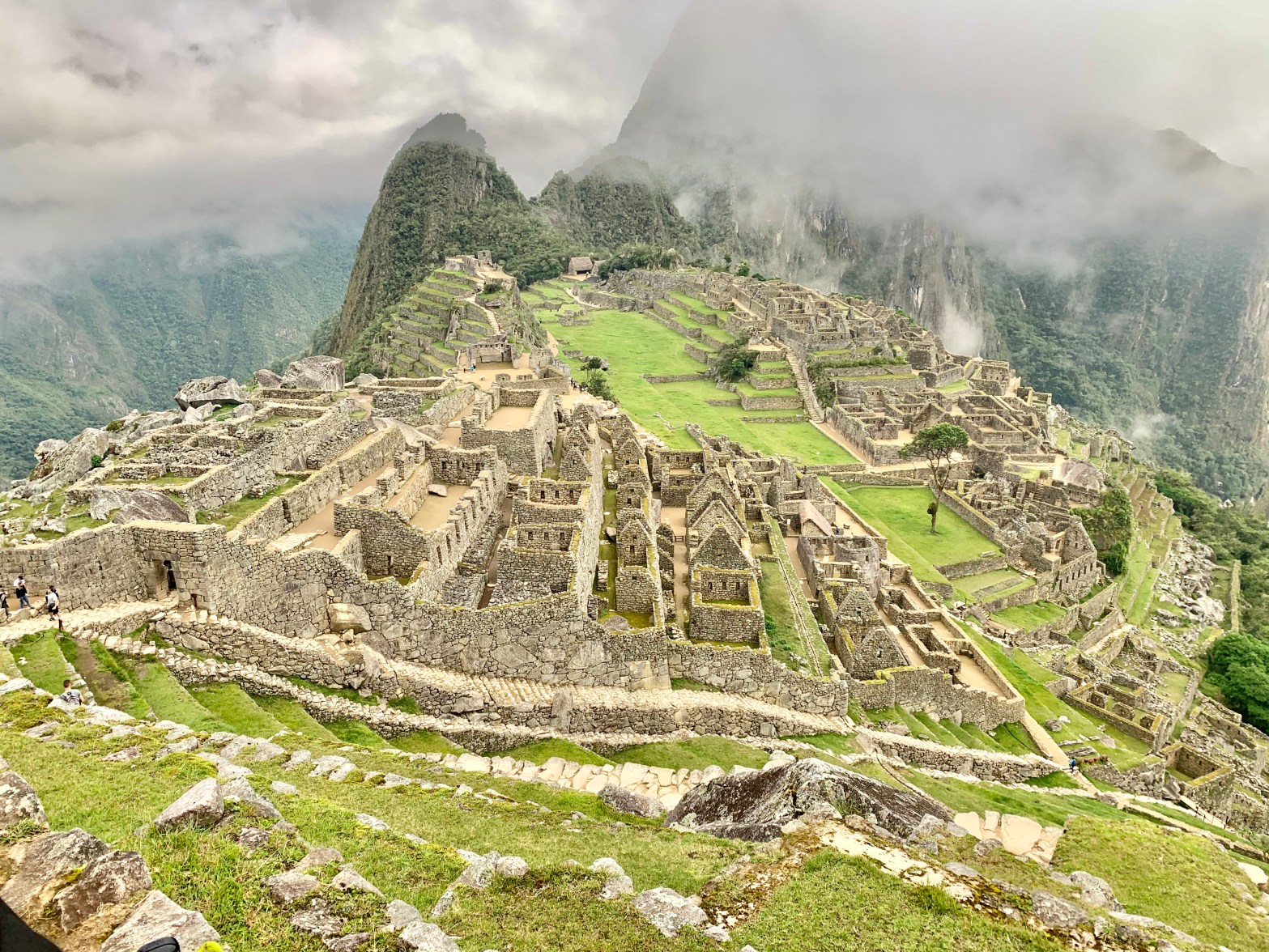
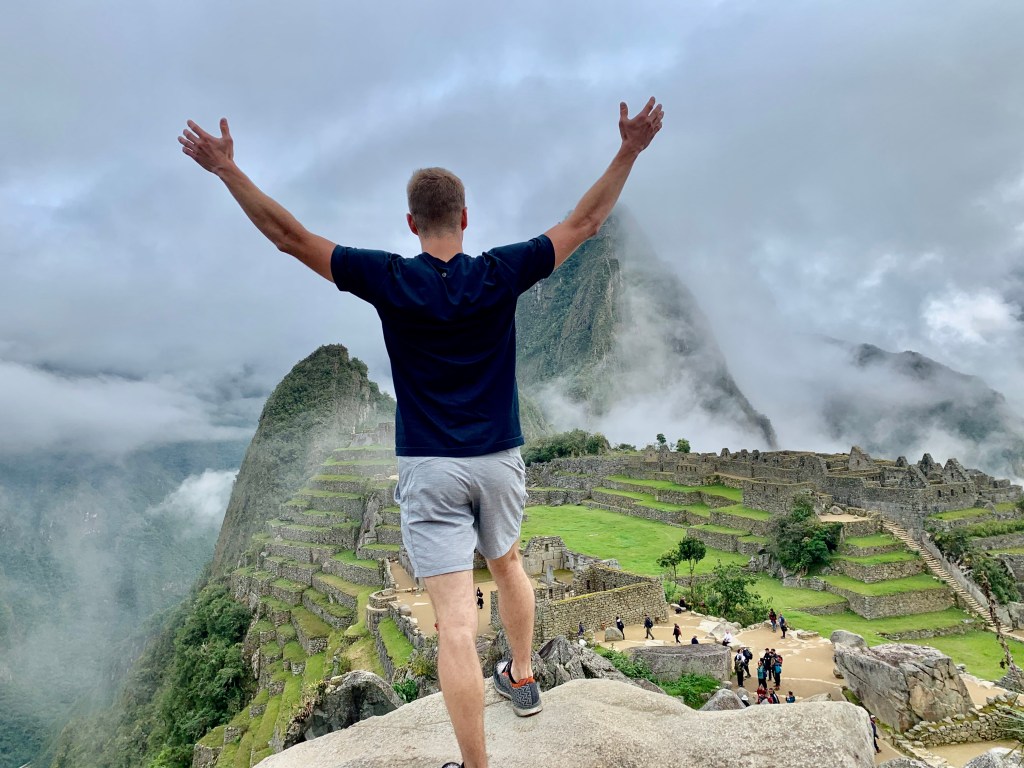
Our day started dark and early at 4 am in a small touristy town named Aguas Calientes. We left so early to ensure we got the best possible viewing time to one of the Seven Wonders of the World, Machu Picchu. We met our group and guide in the hotel lobby and boarded a bus. The previous day we had taken a 4 hour bus ride and a 1 hour train ride to arrive at Aguas Calientes. I was pretty pumped we were here because we had been told we were not actually going to be able to make it to Machu Picchu because the rain had washed out part of the railroad track. However, we made it and the bus ride to the top of Machu Picchu was rather nerve-racking; we zig-zagged up the side of the mountain frantically, with busses passing just inches away and near the edge of a deadly drop-off. Once we reached the top, it was full of tourists and a dense fog. Our tour guide took us up the steps to the entrance of Machu Picchu where we saw a site full of tourists. They seemed to be disappointed as the fog was so dense, you could only see a few feet in front of yourself. However, the guides reassured everyone that by some sort of “divine intervention,” the fog would lift just in time to take our $200 selfie! Even though Machu Picchu was just a summer home for the Inca, it receives a staggering 1.6 million visitors a year! It is Peru’s most popular attraction that highlights the Inca citadel. Sooo why exactly are we here on an honors study abroad trip, if Machu Picchu was just a summer home for the Inca? In my presentation at Machu Picchu I explained how there are essentially 3 eras that shape the narrative of tourism at Machu Picchu. History can help us understand the majority of why the making of Machu Picchu is responsible for such a large number of tourists per year. I also explain what makes Machu Picchu such an important site that elaborates the indigenous ways of the Inca.
The first era occurred from 1900 to 1948, where Peru’s political and economic environment was dominated by a group of elites who had ambitious financial and commercial endeavors. They wanted to shape tourism into an official historical and cultural narrative that emphasized Peru’s national identity. In this time Indigenous culture played a central role in the modernizing national project of Peru. A man named Albert Giesecke is responsible for laying the foundation for future development of cultural tourism in Cusco. He established education reform that created a generation known as the “Generation of the Sierra.” This group had a key role in establishing folklore, indigenismo, archeological studies, and North American institution connections. He is also responsible for linking Hiram Bingham to Machu Picchu. Hiram Bingham is known for “discovering” Machu Picchu on his 1911 expedition to locate Vilacamba, the last refuge of the Inca before it fell to the Spanish forces in 1572. Upon Hiram’s arrival in 1911, he met the Richartes, a family living in the ruins of what we now know to be Machu Picchu. Pablito Richarte, a young boy, can be credited for being the first tour guide of Machu Picchu, as he guided Hiram Bingham around the site on July 24, 1911. This ultimately proved Hiram Bingham’s reputation of being THE discoverer of the lost city false. However, across the world Bingham was known for being the discoverer of Machu Picchu and received national recognition through The New York Times and other major titles. His exploits of Machu Picchu began to overshadow earlier efforts of legislation to protect cultural heritage of indigenous people. Eventually at the beginning of the 20th century, Peru initiated legal reforms in regard to archeological protection that implemented a requirement for state excavations and exploration of artifacts. Prior to his 1911 expedition Bingham received broad permission and priority access over locals However, on his third expedition he angered locals with the exportation of indigenous artifacts to the United States. This began the theme of the Peruvian government picking favor of international people over their locals. With his “discovery” of Machu Picchu, several international travelers visited Machu Picchu, however they discredited the hype saying it was “gruesomely undeveloped and inconvenient to travel in Peru.” This lead the local elite to see a need for infrastructure development. United States visitors began to see a need to travel to the Andes and believed it represented an exotic “other” America. While elite and locals saw a need for more modernization of Peru, the new Peruvian government was strongly against. This was a major blow to Cusqueños. As a result, they reverted back to their old ways to attract tourism through politics, artistic, and literacy to establish their regional identity and folklore to make it compatible to the modern world. Giesecke wrote several articles and labeled Peru “The Mecca of South America.” He highlighted how Cusco could accommodate the modern traveler and how it was far from dirty and outdated.
Elite and locals used three main aspects to begin shaping the narrative of tourism at Machu Picchu in the first era. The first was culture, where Cusqueños authored guidebooks and visualized Inca architecture of the region. They highlighted its appeal in being superior to other global cultural artifacts. Martín Chambi is also known for creating the framing of Machu Picchu; he promoted Cusco’s tourists’ sites by working extensively with Indegenistas and guidebook authors to visually capture the regions touristic qualities. Photography was another tool that focused on architectural sites to create a new narrative for tourism consumption. It invited international travelers to imagine themselves as travelers to faraway exotic sites. Institutional promotion also promoted tourism material through an academic’s perspective. They promoted their increasing number of archeological sites and ruins of Peru. The Peruvian government also greatly overlooked Indegienistas in this period as well. Wealthy landowners also confiscated land from Indian communities, forcing them to relocate. Following these events Indigenistas focused on political efforts to push for more inclusion in national and regional politics. Around this time Cusco began claiming its title as being the center of Peruvian nationality. Cusqueños had employed tourism to craft a narrative that highlighted the region’s modernity and defined their vision of indigenismo. The Quadricentennial, which marked the 400thanniversary of the Spanish foundation of the city was hosted to establish Cusco’s cultural and touristic importance on a national level. They shaped the narrative to use the Quadricentennial to attract outside travelers to Cusco by organizing tourism propaganda in various international regions. This event ultimately gave political and intellectual leaders the tools of tourism to define the regional vision of indigenismo over competing narratives. This lead to increased calls of tourism in Cusco. Elite and government began constructing more roads, railways, and hotels to attract more tourism. They also created the National Tourism Corporation in 1944 which built hotels and increased investments in tourism initiatives. However, despite all these initiatives, the tourism narrative of Machu Picchu still overlooked the grassroots political and cultural demands of Cusco’s indigenous communities.
The second era occurred from 1948 to 1975 and is when tourism is seen as a more positive modernizing force for the Peruvian economy. Developmental tourism initiatives were ceased when Roca Muella resigned from the CNT, who was a strong advocate for tourism development in Cusco and Machu Picchu. Following this, Giesecke encouraged locals to go back to their original grassroots approach used in the first decades of tourism promotion. This mainly consisted of individual volunteers to establish international connections. Another aspect that turned out to be a blessing in disguise was increased seismic activity. Cusco’s government took an opportunity for development and economic modernization through funds provided by seismic activity restoration efforts. UNESCO also began providing assistance in the restoration of Machu Picchu. They also lobbied for the protection of indigenista’s cultural heritage in Peru. However, locals were angered by more outside involvement in the restoration of Machu Picchu, forcing UNESCO to halt their aid. In the 1960’s they began catering towards the “cultured international traveler” and brought in numerous European models to do photo shoots at Machu Picchu. A new government was formed, that strongly supported UNESCO’s involvement with Machu Picchu. This lead to increasing foreign investments in Peru. Hotel Machu Picchu was another initiative by the state to construct a modern hotel adjacent to Machu Picchu; this strongly angered Indigenistas who lead many opposition efforts. The government created the National Culture Institute that assumed control of all historical sites in 1947. During this time period Peru began being seen as an emerging travel experience for the “elite traveler.” They also had an initiative to cater towards backpackers who essentially just brought drugs to the community, causing them to rethink this initiative. They eventually decided to re-create Machu Picchu as a destination for the modern traveler and bring a stronger cultural significance, by promoting indigenous culture of Cusco and Machu Picchu. Machu Picchu was also declared a UNESCO World Heritage Site in this time period, which provided more funding and increased tourism as well.
The third era was from 1975 – 2011 when Machu Picchu emerged as the national symbol of Peru. Tourism began shifting from the locals and state to more privatized outside interests. A militant group, known as Shining Path, bombed a train killing and injuring many tourists. This greatly hindered the perception of Peru being the go-to travel destination. Booming tourism also had drastic effects on the site as well, as it was being overused by tourists. Overuse lead to UNESCO calling for decreased development of Machu Picchu, saying it was destroying the cultural integrity of the site. Locals also expressed much outrage over the highly profitable tourism venues owned by outsiders. Peruvian state officials hosted a lavish party, marking the centennial of Hiram Bingham’s arrival at Machu Picchu and his spark that brought tourism to Machu Picchu. The media and Indigenistas spoke publicly about the false narrative that Peruvian government was shaping, which caused much backlash for officials and the President of Peru. This lead to him trying to swoon the other side, by requesting artifacts Bingham had exported to the United States; a major win for Indigenistas as artifacts were sent back to Peru.
While Machu Picchu was simply a summer home for the Inca, one can see how the making of Machu Picchu and the narrative that was shaped is historical in itself. Elites and locals working together ultimately shaped the narrative of Machu Picchu becoming a national symbol of Peru. While from its origins, the imagery of tourism in Cusco and Machu Picchu has remained an elite-oriented cultural project constructed to serve the outside gaze. However, locals of Peru played a key effort in ensuring the cultural integrity of their heritage. This helped establish the National Culture Institute, which lead to the protection of cultural heritage in Peru. Machu Picchu also became the national symbol of Peru from the effort of many political and economic initiatives. By the 20th century, tourism shifted to adventure travel, ecotourism, and luxury tourism to promote the Andes and indigenous culture as an unchanged naturalist, and purist link to an Inca past.
At the end of our guided tour we were able to see re-enter the site and travel around on our own! We took this opportunity to walk up the Inca Trail to the Sun Gate. The Inca Trail was also made out of stone, however it wasn’t tightly cut together like most of the buildings and terraces at Machu Picchu. The Sun Gate overlooked Machu Picchu, and from the top we were able to see the carve out of a head in the mountains overlooking Machu Picchu. The view from atop was astonishing and we had climbed so high up, Machu Picchu looked small in perspective. Unfortunately, we were unable to hike to the Inca Bridge or the other side of Machu Picchu that supposedly had another outstanding outlooking! However, the hike up the Inca Trail was quite a challenge and provided a phenomenal view of the valley and Machu Picchu.
Multiple aspects of Inca culture are incorporated into this one site. This can make visiting Machu Picchu an all-in-one stop for somebody wanting to learn about the Inca! First, the site is located considerably high; a staggering 8,000 feet above sea level. It is also located at the top of a mountain with a view overlooking the valley and surrounding mountains. Being located on high ground was very important in Inca history, as they valued building atop higher areas. Water was another major feature to the Inca. Machu Picchu was built next to a river, that just so happened to be roaring when we visited. Our guide also showed us several water fountains in the Inca’s chambers. Some of these water fountains even had water running from the mountainside through them. He also explained how there were around sixteen other water fountains at the site as well. There are also over 150 buildings making up Machu Picchu; those consist of baths and houses to temples and sanctuaries. The Inca also built a Temple del Sole, the temple of the sun, at Machu Picchu as well. The Temple del Sole was created in a semi-circular manner and built over a large granite rock that trapped heat. The sacred temple had a trapezoidal window facing the east towards the sun. It was positioned along the curved wall to directly capture sunlight on June 21st for the winter solstice. The Inca strongly worshipped their Sun God in this temple and is considered one of the most sacred temples at Machu Picchu.
Machu Picchu tends to blend in with the tropical mountain forest atop of the Andes. This is thanks to the outstanding craftmanship of the Inca. They built many terraces, stairways, ramps, and walls to blend the architecture into the natural landscape of the mountains. The site also strongly displays the Inca’s landscape engineering skills. Over 700 terraces help shape Machu Picchu. Through their terraces the Inca preserved soil for agriculture uses and also for irrigation. Building these terraces allowed the Inca to create farmland on the side of a mountain. The terraces absorbed heat from the sun during the day, and radiated the heat back out during the night. They filled each terrace with a layer of small gravel and topped them off with sand and fine gravel. The top layer was then filled with topsoil and seeds of corn or potatoes. While the terraces at Machu Picchu no longer are used for farming, one can visualize how the Inca previously farmed by visiting Machu Picchu.
Another important feature about Machu Picchu is its location. It is located in the Cusco Region along the Inca Trail. Thousands of tourists walk the Inca Trail to Machu Picchu every year. The begin at Cuscu and take the 1-5 day trip on foot to Machu Picchu. The Inca Trail travels through the town of Ollantaytambo and travels up the to the lost city. We actually got to hike up the Inca Trail when we were hiking to the Sun Gate. The Sun Gate was located about two and a half miles uphill from Machu Picchu. It was a a very challenging hike, so I am sure a 1-5 day journey along the Inka Trail would be quite the challenge. I find it funny that the Inca Ruler also had to make this journey on foot or by alpaca, since they did not have any other form of transportation.
Ultimately, Machu Picchu is truly an extravagant site that should not be overlooked when visiting Peru. Machu Picchu is full of such a rich history and information about the Inca. It portrays all aspects of Inca architecture, engineering, rituals, and lifestyles. Machu Picchu’s history is ideally one of a kind and the narrative that was shaped to the world by leaders of Peru have taken the hype of the lost city to a whole new level. While our day at Machu Picchu was one of the LONGEST, I will never forget the breathtaking site and the history in the making of such a elicit site. If you ever get the chance to visit Machu Picchu, I strongly recommend. I also highly recommend arriving to Machu Picchu as early as possible as there are less tourists in the morning. While the dense fog might be a slight turn off in the morning, I can assure you along with ALL the tour guides, some sort of divine intervention will lift the fog early in the morning for the view of a lifetime! I also recommend travelling to Ollantaytambo on your way to Machu Picchu, as it provides rich history on the Inca too – and if you are feeling really adventurous, travel along the Inca Trail. The trip to Peru and Machu Picchu were most definitely one of the top highlights of my life and something I will cherish forever. While the Inca may now cease exist, their vast history and remaining ruins will leave you in awe at the amazing wonders of their empire.
 Indigenous Ways in Peru: Postcards from Students