By: Gigi Powell
There lined the museum shelves rows and rows of pots, jammed together, each standing, arguing for attention, to be noticed over the others. The museum barely had enough room for them, and even barely could be considered an overestimate, as if rooms and rooms of pots displayed less than 5 inches from each other with little to no description was a display worthy of the mastery of the pots. To be fair, within the actual part of the museum, there were pots with proper explanations as part of the different exhibits, but the main, jaw-drop worthy portion of the pots was in the aptly named “visible storage” areas in a separate area. Even the name “visible storage” implies that there are more of the pots, sitting in a dark room somewhere, hopefully being studied but probably not.
We wandered through the storage area for maybe 5 minutes and barely scratched the surface, walking through row after row of towering shelves, the sheer numbers of the pots beating in like humidity on a hot summer’s day. Had I allotted more time to the discovery of the visible storage area, I would have searched in vain for the end. It reminded me of a bookstore on Dixon Street back in Fayetteville. Every time I go I swear to myself that this time will be the time that I find it, the back of the bookstore, and every time I think I do until I see another room smiling at me from beyond a lined bookshelf. The pots, when studied on their own, were in beautiful condition, the red and white and black clays bragging intricate, fascinating designs, but when taken in as a whole, the result was almost suffocating. The most shocking part about taking in the pots in person is that the map of the museum shows about eight rooms that contain these pots, which, despite being the equivalent of a medium sized house in room number, doesn’t seem that outrageous. Seeing the space in person, you also get to account for height, which is a large part of what makes the space seem so overwhelming.
The museum in question is the Museo Larco, named after Rafael Larco Hoyle (1901-1966) (Evans p.233). Rafael Larco Hoyle was an interesting character, his reputability argued by many of the sources I could find on him. Some praised him as having “exhibited an intimate knowledge of the tens of thousands of objects in his museum,” while others described his works as biased and self-convicted (Evans p.235) (Scott p.93-95). It is agreed upon, however, that his visual depictions of Andean artifacts, specifically the infamous pots, are the “real justification for the publication of [his book, Peru] for Europeans and non-Europeans alike” (Schaedel p.824). His pots are his real claim to fame, though, the pieces that he acquired from his uncle and his father as a gift in 1925, and the ones that he collected as part of his archaeological practices (Evans p.235). The pots, or rather, the care and collection of the pots is the curious part, for, although Rafael Larco Hoyle was an archaeologist by the standards of the time, his practices in reality betray more of the aspects of a collector.
Why Can’t the Archaeologist and the Collector Be Friends?
The main difference between the collector and the archaeologist is the context in which they view the object. The collector, normally of art, views the object as an object itself. If they see something as physically beautiful, they are going to regard it as such, even if the people in the time that it was made would have thought it the most mundane thing in the world. Collections are interesting too because there are no real limitations on where the object can and cannot be stored. If a wealthy person wants to hang a beautiful object in their home, the piece becomes simply an object of decoration for that person (Colburn p.38). Some collections do end up in museums, but once again if they were collected as an art piece that is most likely what they will be displayed as (Colburn p.38).
Meanwhile, archaeology attempts to place the object discovered in the cultural context of the civilization that created it. If an archaeologist dug up the most beautiful object they’d ever seen, they would first try to figure out the context in which it was created, and (in a perfect world) if the object ended up not being culturally significant it wouldn’t have as much importance placed upon it. Placing the objects in their context is a more accurate representation of indigenous cultures, it does rely heavily on archaeologist interpretations, and, while archaeology has come a long way, for a while it was used as a means of colonization, treating the objects discovered more as a collector would than an archaeologist. Even after colonialism, “in Latin America, dictatorships during the Cold War used archaeology for their own purposes, supported by the United States, whose democratic credentials were not enough to moderate autocratic rule and abuse of archaeology” (Funari p.120). If the archaeologist’s interpretation is off, it impacts the views about the object, and so if someone wants to shape a culture’s history, they can control the interpretation of the object. However, like most modern academic disciplines, archaeology is a fluid state and most people accept and anticipate discoveries that will alter the field in the future.
Collecting and archaeology can, at first glance, feel very similar, but their importance lies in their motivations for discovering artifacts. For instance, imagine that you have a bowl. It’s a cute bowl, I’ll give you that, but it’s just a bowl, and although you really like the pattern (there’s little alpacas on it, come on, this is a blog about a Peruvian trip), your main enjoyment from the bowl comes from what you put inside of it. You eat your favorite soup from it; you consume cereal at late hours in the night while binge-watching Netflix, and that’s what makes the bowl so special. Yes, it has alpacas on it, and yes, the alpacas are wearing sunglasses and little shoes, but in the end it’s just a bowl, a vessel for food, and you wouldn’t consider it anything deserving of special treatment.
A Section in Which I Discuss Your Soup Vessel Extensively
Now, imagine, years from now, and I’m talking years, as in you and everyone you love is dead and has been for a very long time– your bones are decaying somewhere in a nice cemetery (they don’t get discovered for another hundred years)(you’re currently under a newly-constructed Walmart because we all know that those are eternal). There is, however, an archaeological dig happening in the very space where you last consumed soup from that awesome alpaca bowl, and it’s about to be discovered. Now, depending on whether these future archaeologists operate more as collectors or more as archaeologist, your beautiful bowl can end up in one of two places. First, if the future archaeologists are more collectors, then one of them will see the bowl, decide it is the most beautiful thing they have ever laid eyes on, and they will give it to the rich person who has commissioned the dig and the rich person will mount it on their living room wall so that they can show it off to all the other rich people who come to visit.
However, if the future archaeologists are, indeed, honest to goodness archaeologists, they will see the bowl, and, while it still could be the most beautiful object they have ever laid eyes on, they will put aside those personal feelings of beauty and grace and will instead look to their research and the research of their colleagues and discover that you ate soup out of this bowl and it served no cultural significance in your world. It will then be written about and most likely displayed in an archaeological museum in the middle somewhere with other cutlery and dishes and cups, important enough to be displayed before, say, fossilized toilet paper, but not nearly important enough to be put before the Gucci belt of the same era.
The Part for Which the Blog is Named: The Soup Bowl Conundrum, Machu Picchu, and You
Why did I just spend ~literally~ 430 words describing to you the schematics of your future soup bowl instead of recounting the details of my fabulous trip to Peru? Because, if you go to Peru with no knowledge of what I will be from here on out referring to as The Soup Bowl Conundrum, you will be like those ignorant future humans who find your soup bowl and consider it a glorious piece of art and hang it on their wall like the idiots they are. There is an abundance of instances of The Soup Bowl Conundrum in Peru, which become a lot more apparent when you’re aware that things like that actually exist. It also promotes a healthy dose of curiosity, if not skepticism, and will help you to determine what aspects of your trip is real indigenous culture and what is hyped up to appeal to the tourism industry.
I will start by going there: the most famous instance of The Soup Bowl Conundrum is perhaps the one that brings the most people to Peru– Machu Picchu. Yes. I went there, literally and figuratively. Machu Picchu was “discovered” (AKA a white man saw it and took all the credit) by Hiram Bingham in 1912, and the “discovery” was recounted in Bingham’s book Inca Land (Poole p.124). Bingham’s descriptions of Machu Picchu add to the sense that he, much like the future rich person who hangs your soup bowl on their wall, is anticipating Machu Picchu to be this huge discovery, a pivotal point in understanding the Incan Empire. However, although Bingham did see Machu Picchu as a great lost city, “what captured Bingham’s imagination was not the immaculate Inca masonry of the walls that surrounded him, but rather the ‘tantalizing glimpses of snow covered mountains’ that he caught during breaks in the clouds” (Poole p.124).
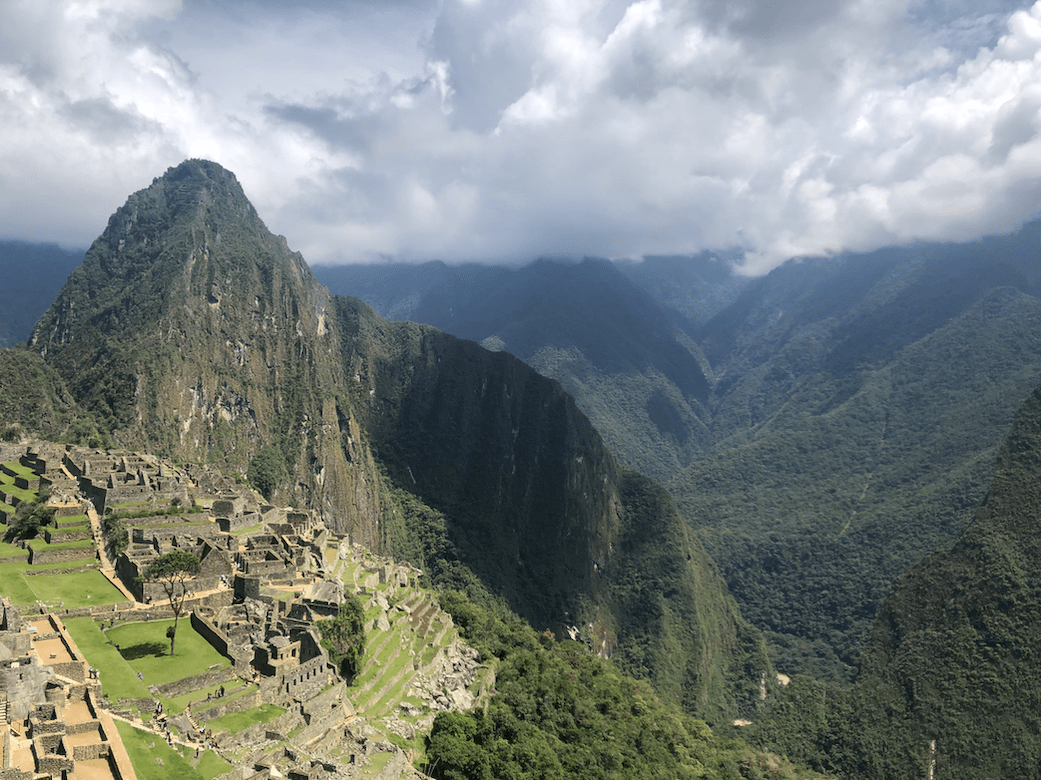
I stood at Machu Picchu and watched as the fog rolled across the ruins, turning the landscape from a void of white mist to a fully formed landscape with towering, breathtaking mountains, with this sprawling stone structure tucked away in one of the crannies. I also happened to take pictures, which I was kind enough to include below.


The view was perhaps the most stunning part of the site, the draw that brings thousands of people to Peru every month, if not week, if not day. Bingham had “discovered” something beautiful, but not particularly culturally significant. In fact, all that Bingham had been led to was a summer palace of an Inca, similar to a Versailles but of Peru and in the 1400s. The question then becomes why is Machu Picchu a national heritage site, instead of, say, Ollantaytambo, a site that was much more culturally significant to the Incas but remains a less popular tourist destination. My answer is that, among other things, Hiram Bingham tipped the first domino in an extreme account of The Soup Bowl Conundrum.
Hiram was operating as an archaeologist, but with a collectors mindset. The mentality surrounding the Andes at that time cherished the perceived untouched beauty of the Andes, but it ignored the shaping of the landscape of indigenous people, instead painting them as ignorant savages, among other things (Poole p.114). Bingham took this emphasis on the natural world in the Andes and enhanced it, glorifying Machu Picchu as a lost city and spreading ideas about it in North America. It was during this time that Machu Picchu became such a tourist destination, and as the decades went on and the tourist industry surrounding the site only grew Peru acknowledged the fascination with the site and played it up.
A curious phenomenon has happened with Machu Picchu though. The site did not hold much weight for the Incas– it was simply a summer home for an Incan noble. Modern Peruvians have created a new identity for Machu Picchu, one that combines a strong Incan nationalism while also taking back control over their cultural heritage in a way. Peruvians have embraced the icon that Machu Picchu has become, whether for show for the tourists or from a real fire in their hearts to embrace their national history. This is where the knowledge of The Soup Bowl Conundrum comes in handy– before I had done much research I believed that Machu Picchu held significant status in the Incan empire and that was why it had become such a must-see attraction. After learning about The Soup Bowl Conundrum and Bingham’s archaeology that better reflected the influences of a collector, I understand that Machu Picchu holds so much weight now because modern era humans have instilled it with that importance. We go take pictures in front of Machu Picchu because everyone goes to take pictures in front of Machu Picchu, and without understanding where our assigned significance comes from, it is very easy to get caught up in the touristic masses who are consuming the culture and spaces of Incan and indigenous Peru.

I will admit that Machu Picchu was gorgeous; I am not denying that it holds a special place in the modern traveler and Peruvian’s heart. What I will say is that the significance placed upon Machu Picchu is a recent development, and even though the Incas would not have placed as much importance upon it as we do currently, it does not mean that the evolution of Machu Picchu as the cultural monument is a negative thing. It brings a fair amount of revenue to the country, and provides a point of pride for the Peruvian people today. You should go to Machu Picchu if and when you go to Peru, because it is currently an important site and you can take a picture in front of it and caption it something nonchalant like “I see you, Machu Picchu” and stunt on that girl who always humble-brags about her vacations by posting a picture of her in front of some beach.
I did not mean for that to sound so bitter, but the main point is that if you want to go to Machu Picchu, you should go to Machu Picchu. But, remember The Soup Bowl Conundrum, and when you want to go to Machu Picchu, go ahead and schedule that day in Ollantaytambo, to get a sense for what is important for modern Peruvians, and what was significant for the Incas in their time.
So, you visited Machu Picchu, it was fabulous and you got to take a selfie with a llama similar to the one of me right below this sentence.

You got to be a collector, a consumer; you went to Machu Picchu not because of the cultural context in which it was created but because millions of other people have made the pilgrimage and it’s a really beautiful place. You should have no shame, honestly. I went to Machu Picchu and I loved it. I hiked around and I took the above selfie with a llama, who is now my best friend. I took more than one picture of myself with the Machu Picchu ruins in the background, and if I was going back to Peru I would do it again. The main point of me spending so long explaining the difference between archaeologists and collectors and The Soup Bowl Conundrum is that if you want to contextualize the Incas, you have to go to different, often less popular places. And, if you’re not lucky enough to travel to Peru with two professors who have literally dedicated years of their life to understanding the history of the country, then at least you are lucky enough to have me, a girl who spent 12 days in Peru with those two professors, outline some places that were significant to the Incas based off of what I picked up from those two professors. A fair trade, if we’re being completely honest (and by “completely honest” I mean “not honest in the least bit; if I were Pinocchio my nose would be at least three feet long). If given the option, definitely discuss your Peruvian itinerary with an expert. If you do not have the option, or if you just don’t want to work that hard (which is also respectable), continue reading.
Ollantaytambo: Not Just a Stop on the Way to Machu Picchu
Perhaps most important site to visit would indeed be the one that I have happened to already have mentioned twice: Ollantaytambo. It is often referred to as the Sacred Valley of the Incas, and if I am (actually) being completely honest, the only real reason why I am mentioning Ollantaytambo now is because one of the two aforementioned professors, during the time on Ollantaytambo, said that it was more culturally significant than Machu Picchu and that it was probably more deserving of all the hype. I do remember that it was home to large structures that would have been used as backup storage for water and food. We also learned from a site report that it was also another rich guy’s house and surrounding land, but that the real significance comes from a battle won against the Spanish when they came in the 16th century. As we know now, the Incas did eventually fall to the Spanish, but the remembrance of the victory sealed the identity of Ollantaytambo as an important place for the Incas.
If you are still reading this blog, at this point I believe that you have gotten the gist of my message and you are most likely going to be a curious and conscientious tourist, keeping in mind whether your attitude towards the sites and lifestyles you are exposed to veers towards that of a collector mindset or that of an archaeologist. It is also worth noting that collecting is not inherently bad, nor is archaeology inherently good. Some collectors donate their collections to museums, where they can be seen by much larger populations than if they had remained in the home area. Some archaeologists ignore other scholarly works and instead interpret artifacts in ways that could be true but probably not, setting the field back. The main thing is to notice when these things happen, and, during your time in Peru, to be diligent at spotting these things, but, also, it’s okay to take your picture in front of Machu Picchu. Just admit that you understand the reasoning behind your picture-taking, and then flaunt that fit you spent all trip planning.
Works Cited
Colburn, Forrest D. “From Pre-Columbian Artifact to Pre-Columbian Art.” Record of the Art Museum, Princeton University, vol. 64, 2005, pp. 36–41. JSTOR, www.jstor.org/stable/3774832.
Evans, Clifford. “Rafael Larco Hoyle: 1901-1966.” American Antiquity, vol. 33, no. 2, 1968, pp. 233–236. JSTOR, www.jstor.org/stable/278526.
Funari, Pedro Paulo A. “Historical Archaeology and Global Justice.” Historical Archaeology 43, no. 4 (2009): 120-21. www.jstor.org/stable/25617586
Poole, Deborah. “Landscape and the Imperial Subject: U.S. Images of the Andes, 1859-1930.” Close Encounters of Empire: Writing the Cultural Historyof U.S.-Latin American Relations, edited by Gil Joseph et al., Duke University Press, 1998.
Schaedel, Richard P. American Anthropologist, vol. 70, no. 4, 1968, pp. 824–824. JSTOR, http://www.jstor.org/stable/670623. Accessed 19 Jan. 2020.
Scott, John F. The Hispanic American Historical Review, vol. 48, no. 1, 1968, pp. 93–95. JSTOR, http://www.jstor.org/stable/2511413.
 Indigenous Ways in Peru: Postcards from Students