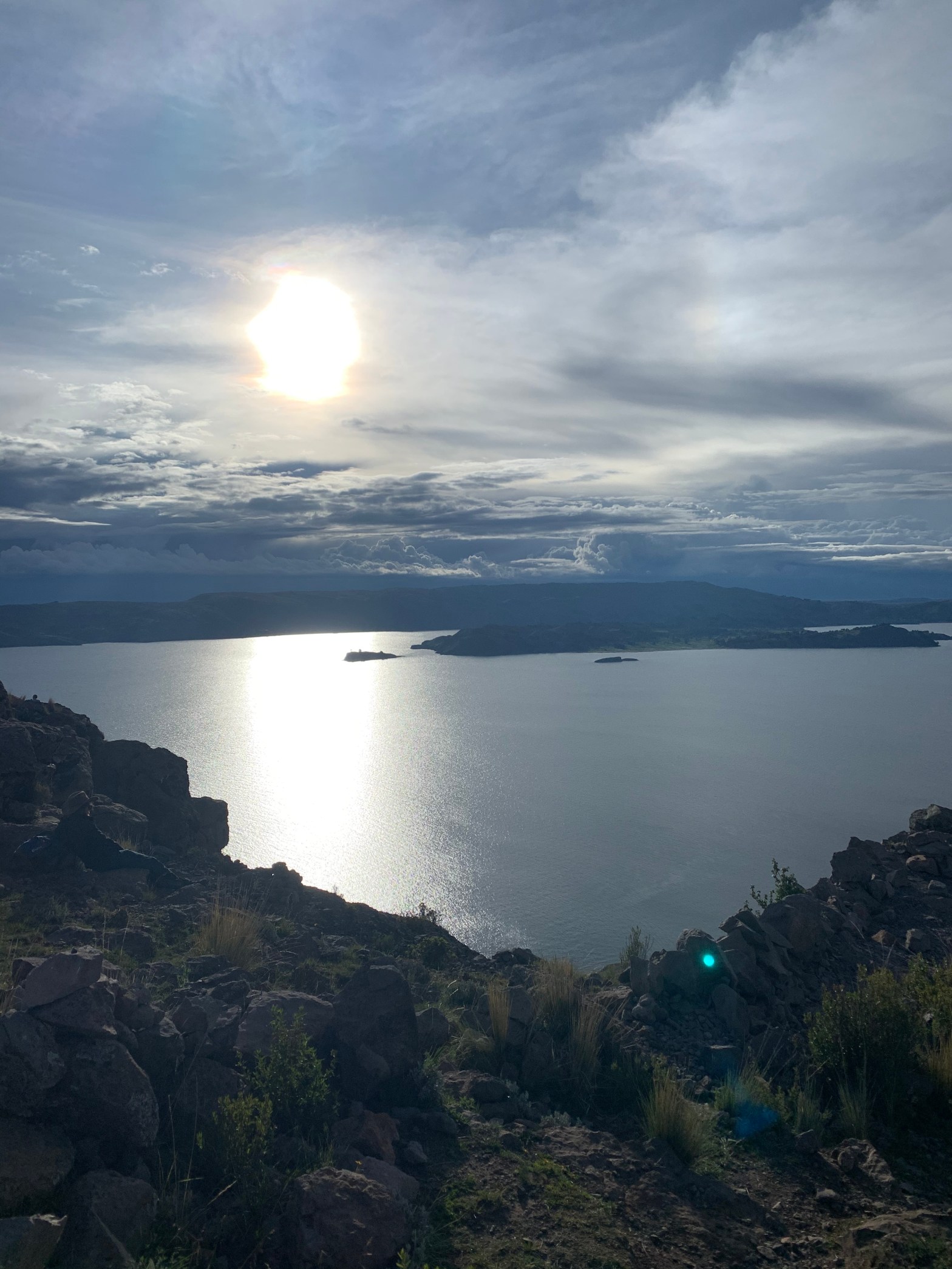
The freedom of movement, which is guaranteed to me (and you) by the Universal Declaration of Human Rights, is wonderful to have. Because of it, I was able to leave the United States and enter Peru and then travel all around Peru. But this human right only applies to movement between and within nations. What about between and within private properties? What about within the commons? I would think about this a lot during our trip.
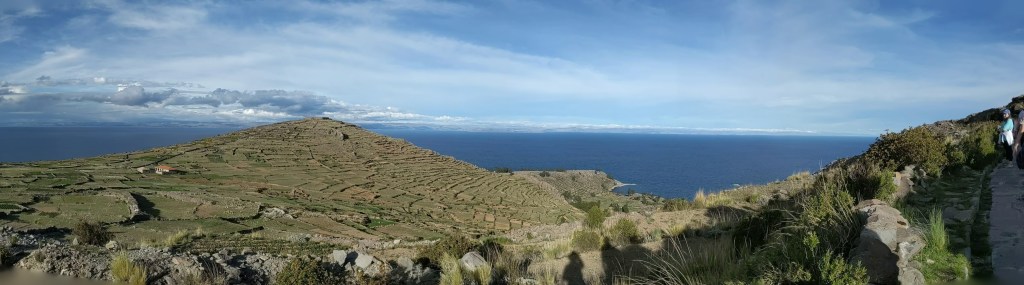
Our trip itinerary was organized around museums, buildings, artifacts, and archaeological ruins, but one of the most impressive things I experienced on this trip was the variegated and quickly changing landscape as we moved from place to place. I remember looking at Machu Picchu after the fog completely cleared, able to see and appreciate the whole thing, and thinking, Well, it’s kind of more of the same. What I did find worthy of waking up at four in the morning was the location and the views that came with it. The manipulated and natural landscape was a highlight for me on this trip. We traveled from sea-level to 12,000 feet. One hour our tired feet would be shuffling on the cobblestone streets in the bustling downtown of Lima, the next hour they would be climbing sandy hills in the desert, the next hour they would be sinking in the sand in the cool Pacific Ocean. One minute you could be descending and slipping down the terraces on the face of a mountain, the next you could be on the steps of a magnificent altar, neck craned, eyes on Our Lady of Los Remedios.
I gave my in-country presentation on the changing concepts of land and land ownership on top of Pachamama (which means “Mother Earth” in Quechua), a mountain on Amantaní Island in Lake Titicaca, as the sun went down. I wondered if the beautiful view behind me of the lake and other surrounding islands served as a contrast to the ugly practice of privatizing common resources, the audacious idea that one could ever own a part of Mother Earth, which is a notion that is not only common in the capitalist world but is embedded in its institutions.
Sapci, or the commons
The earliest concept of land use and possession was under the framework of a word called sapci. Sapci is a word that best translates to the commons. The commons could refer to any and all resources, including land, water, minerals, and guano among other things. Under the framework of sapci, anyone could have rightful claim to a resource if they were using it fruitfully and without waste.[1] So, to claim and have a piece of land, one must cultivate the land.
To us, this concept initially appears as a foreign one. The first question to arise would be, how does one register and defend their possession of a resource is anyone is free to take and use it? Some communities have records of a ritual surrounding the claiming of land in order to “register” it. One example is the coastal community of Lambayeque, which dates back to the late 16th century. If someone was claiming a piece of land that had a known history of previous possessors, the new family made offerings and sacrifices to their memory before beginning to cultivate. They would name all the tillers of a piece of land that they could in chronological order in order to “register” their possession.[2] Some families placed stones in the middle of the fields which represented past tillers to which current tillers presented offerings and sacrifices for a successful and abundant harvest.[3] This practice shows the intimate relationship between Andeans and the land through its emphasis on paying respects to previous tillers and caretakers. It particularly reminds me of the western theology of stewardship that says that humans are responsible for taking care of the environment. The valuing of earth and its resources is a constant, but it is expressed in different ways among cultures.
One’s right to the land that they cultivate continues until it is given up. This could be for several reasons, including, but not limited to, the infertility of the land, drought, and death without heirs, in which case the land eventually reverts to its natural state, available for another family to claim and cultivate. With the understanding of sapci, rather than owning land, one cultivates and takes care of it.
The erosion of sapci
During the colonial era, the concept of sapci was challenged. Andeans slowly began to lose land. The encomienda system had a devastating impact on the commons. The combination of the exploitation of indigenous laborers and the introduction of diseases led to a severe depopulation which the Spaniards mistakenly or willingly understood as the vacancy of lands. They used as grazing pastures where the land was suited and grew livestock on these “unused” lands, encroaching on indigenous livelihoods. These Spaniards would transition into the first settlers. There is evidence to suggest that encomenderos intentionally kept their laborers from working their own land.
“…1541, encomenderos kept their charges so busy that they had no time to plant and (in the long run) lost their fields, and that Spaniards took the lands of dead natives (to the chagrin and suffering of their families).”
Ramirez, Susan E. (2016) “Land and Tenure in Early Colonial Peru: Individualizing the Sapci, “That Which is Common to All”,” The Medieval Globe: Vol. 2 : No. 2 , Article 4, 44.
During this time period, the colonies collected a tribute tax levied only on indigenous communities which was to be paid in commodities such as foodstuffs and, later, partially in cash. The result of the tribute tax on land enclosures was that the foodstuff contributions of the indigenous communities controlled the Spaniards’ demand for agricultural land, which in turn controlled some of the land enclosures. However, enclosures of the commons would be encouraged and accelerated after Peru’s independence.
The exploits of Liberalism
In the mid-19th century, a caudillo by the name of Ramón Castilla became president in the emerging young nation of Peru. In 1854, Castilla abolished the tribute tax. He said:
“…starting in 1855 the indigenous contribution is suppressed, and thenceforth they will not contribute except in the same way that the rest of the inhabitants of Peru do…Emancipated from the humiliating tribute imposed upon its head three and half centuries ago, and elevated by the natural effect of civilization, Peru will gain a numerous and productive population in the indigenous race, which will undoubtedly offer her a richer contribution.”
Mark Thurner, From Two Republics to One Divided: Contradictions of Postcolonial Nationmaking in Andean Peru (Durham: Duke University Press 1997), 52.
Castilla was hailed for emancipating the indigenous population of Peru, for lifting the unfair tribute tax, for treating Andeans as Peruvians equal before the law. This was the liberal revolution, a dream to be fulfilled. On paper, it upheld and embodied all of the liberal ideals that Peru needed to instill. However, Castilla and his succeeding liberal presidents failed to follow through on this change. They failed to successfully implement alternatives to the tribute tax, a universal taxation plan that would pass congress and also last. But Lima could not control the politics of the hinterlands.
Landlords took advantage of Lima’s decentralized control and successfully enclosed commons, dispossessing many Andeans of land. This created a landless indigenous peasantry population searching for work. Landlords took advantage of the indentured indigenous labor. The liberal state also encouraged leasing out community lands and expropriated Church properties, increasing enclosure pressures on peasant communities.[5] Thus, the system of paying tribute to the state was replaced by a system of tribute to landowners as they enclosed land and charged fees for access and use.[6] It was often the case that indigenous people that were made landless by the enclosure ended up working on the same fields that they used to work, but for their landlords.
Peru’s leaders believed that the new nation could strengthen its economy if they passed policies to maximize productivity. It was the liberal stance to believe, like we in the capitalist system do, that the way to do this was to encourage the private ownership of resources. They took no issue with incorporating the indigenous population into the “productive population,” as Castilla said.
Dead capital?
Fast-forwarding to today, we see the impacts of the neoliberal vision playing out on modern Peru. Raised and educated in Switzerland, Hernando de Soto Polar, Peru’s most well-known economist, coined the term “dead capital,” which is the concept that informally held property is less valuable than property that is legally recognized. There is an immediate tension between this reasoning and the philosophy behind sapci. It is a dismissal of the value of the commons and traditional indigenous conceptions of land. Implied in the definition of dead capital is that value is determined according to what is legible to institutions. This further excludes marginalized communities.
De Soto supports his theory by arguing that the best way to protect indigenous land rights is for them to secure title to their lands. The land and property of indigenous people is protected under the Peruvian constitution, but de Soto does not believe that this holds up under the pressure of foreign investors. However, though there is plenty of empirical evidence that securing private property leads to capital accumulation, there is no empirical evidence that it defends land rights.
One example of how land rights have been plowed over by foreign companies is the story of the resettlement of Morococha by the Chinese mining company Chinalco. Chinalco built a new town for the resettlement of Morococha, a site of a large copper deposit, and has tried to incentivize those who refuse to move with quotes for buildings and other property, but not for the land, and certainly not for the profitable minerals underneath the surface.[7] In this situation, the company is able to completely ignore and refuse to recognize the land ownership rights of the residents with impunity. This is among the biggest copper mining projects in Peru, slated to expand on a budget of $1.36 billion USD. Lima will never take the side of the few remaining families in Old Morococha over Chinalco, and it is very easy within Peru’s institutions to transfer ownership of land. The company cited two laws to take ownership of 34 hectares that previously belonged to the municipality of Morococha.[8] One was a statute that barred land ownership in high-risk areas. The other declared that owners shall not have a say in any expropriations that the government deems necessary and that all housing in hazardous areas are uninhabitable.
Hernando de Soto Polar’s argument that if one has the right to land ownership it will be recognized by extractive companies and left alone is flawed because it does not take into account the strength of the legal institutions of Peru and the obvious and severe inclination of the Peruvian government to support decisions and policymaking that facilitate foreign direct investment. However, the Peruvian government benefits from individual land ownership because this makes land easier to buy and sell and therefore easier to consolidate. The ease of consolidation of land is good for foreign investors and more attractive to them than the idea of fighting indigenous communities for the commons. If we want to defend indigenous land rights, we should find ways to defend the commons, not split them up into individual plots.
One grave problem with depicting privatization as a cure-all is that it frames capitalism as a saving or liberating system for indigenous people. I argue that this could not be further from the truth. De Soto sees migration to shantytowns on the edges of Lima and praises it as a step that is part of upward mobility for Andeans. He believes that these slums are paragons of entrepreneurial hubs that are only held back by their informality.
Peru has chosen foreign direct investment as its primary avenue of development. The government is inclined to take the side of companies when there are disputes over what belongs to indigenous communities. During the trip, we observed a lot of signs in Chinese as well as many Chifa restaurants, which served Cantonese-Peruvian fusion cuisine. The restaurants indicated an existing Chinese-Peruvian demographic. These were a few of the examples of how Peru encourages Chinese foreign direct investment.
When people are asked to think about how indigenous people adapt to or practice capitalism and “western” ideas, they often point to the tourism industry and the commodification of their cultures and cultural exchanges. The issue of land ownership is not an obvious one to point to. But during our second week, the class was asked to read “Andean Translations: New Age and Cultural Exchange in the Sacred Valley” by Macarena Gomez-Barris. From this article, we learned how tourism and the issue of land ownership intersect. The influx of non-nationals in the tourism industry drives up the property values out of the reach of people who actually live in the area. This has occurred in the Sacred Valley with Q’ero communities; as foreigners from North America and Europe buy up property in the valley, Q’eros are both figuratively and literally being pushed to the margins.
Closing thoughts
The Q’ero story is one of a tragic contradiction. Our freedom of movement as tourists denies the freedom of movement of Q’eros in their own home country. It is true that this is the result of many layers of interlocking gears of problematic mechanisms and systems and histories of colonialism and neo-imperialism. But in this increasingly globalizing world, it can be difficult to see the relations between our actions and their impacts on someone else.
The commons is for all, and the privatization of the commons should alarm anyone who enjoys their freedom of movement. From sapci to “dead capital,” we have seen how the freedom of movement of indigenous peoples has slowly been chipped away in Peru. For the tourist, the freedom of movement is about getting through customs, and this freedom is granted (usually) without any hesitation. For many people in Peru, however, the freedom of movement is about access to life-giving resources, access to land, and for some, the right not to be removed from your home, and this freedom is oftentimes denied. I wonder what Pachamama would think about this injustice.
I am not saying one should never leave the country again to be a tourist somewhere because, unfortunately, that would make no difference. What could make a difference, however, is to know about the commons, to take care of them, to defend them, and lastly, to be grateful for them from time to time.
References
[1] Ramirez, Susan E. (2016) “Land and Tenure in Early Colonial Peru: Individualizing the Sapci, “That Which is Common to All”,” The Medieval Globe: Vol. 2 : No. 2 , Article 4, 38.
[2] Ibid.
[3] Ibid.
[5] Mark Thurner, From Two Republics to One Divided: Contradictions of Postcolonial Nationmaking in Andean Peru (Durham: Duke University Press 1997), 52.
[6] Thurner, 44.
[7] Gonzalo Torrico December 5, 2018. “The Chinese Mining Giant and the Ghost Town.” Dialogo Chino. ChinaDialogue, August 30, 2019. https://dialogochino.net/15576-the-chinese-mining-giant-and-the-ghost-town/.
[8] Ibid.
 Indigenous Ways in Peru: Postcards from Students