By Beck Williams
I need to begin by saying: I do not like rain. I never have. As an avid hiker, camper, and person who enjoys being dry, rain has always been near the top of my list of inconveniences. Encountering a rain storm on a typical Arkansas hike can turn what was a joyful walk through the forest into a sticky, dreadful experience. Rain while I am camping means I will have to take extra precautions to keep all of my equipment dry, and when I leave the solace of camp, I will have to pack up wet equipment and a soaked tent only to then have to dry everything out upon my return home. While some people enjoy being outside in the rain, I simply do not understand. The horrid slosh of wet shoes and socks, the heaviness of soaked clothing, the blurred vision from fogged-up glasses, the mud stains around your lower pants (or higher up if you slip!), and of course the irksome thought of how long it will take to completely dry off—rain is truly not for me.
This is why, of course, whenever there is any chance of rain whatsoever, my umbrella is always with me. It may seem dramatic, but an umbrella—specifically, my umbrella—is one of my most important possessions. It goes everywhere with me, and on the incredibly rare occasion that I find myself in the rain without it, my only thought the whole time is that I wish I had it with me. Any rainy walk across campus or downpour while hiking can be thoroughly and immediately improved by the presence of my open umbrella above me. My umbrella is the perfect size. It compresses down small enough to fit into a small bag or into the outside pocket of my backpack, but at the same time, it conveniently unfolds into a large enough area to keep myself, any backpack I am wearing, and even a second person nearly completely dry. On top of this, ever since I received it from my sister on Christmas Day a couple of years ago, it has not shown any signs of damage or wear in the slightest. For the amount of traveling and walking through the rain that I do, it is, without exaggeration, the perfect umbrella.
Of course, you can imagine how much I used this umbrella during a two-week study abroad excursion in Peru. Because of its location close to the equator, seasons behave differently in Peru than they do in the United States. Instead of four distinct seasons, Peru experiences only a “wet season” characterized by rain and humidity and a “dry season” which is sunny and arid. Our program took place directly in the middle of the wet season, and as a consequence, it rained nearly everyday, sometimes multiple times a day and sometimes for hours at a time. I was not about to let my disdain for the water cycle take away from the experience of a lifetime, so my umbrella was with me at every second, and I never hesitated to pull it out and open it up. However, what I did not realize was that this umbrella would actually lead me to my favorite experience of the entire trip and would teach me what was possibly the single greatest lesson I learned over the two-week program.
Our program was largely focused in learning about and understanding the relationship between the indigenous culture of the Andean people and the modern Peruvian culture. It involved visits to important cultural, historical, and religious sites across the Andes. These site visits typically inspired thoughts and discussions comparing aspects of Andean cultures with those of our own. For these instances, I needed to be aware that I was experiencing these sites and aspects of Indigenous Andean culture while looking at them through my own cultural lens. My only previous experiences abroad had been in Europe, where the languages may have been foreign to me, but the major aspects of culture still remained the same. In traveling to Peru, I faced a higher possibility of culture shock than I ever had before. I had never experienced anything quite like arriving on one of the Uros Floating Islands in Lake Titicaca, where around 25 people lived on one self-made island of an area around what I estimated to be approximately 150 square feet. Compared to the culture I have grown up in, this seems insane—I could hardly imagine spending the majority of my life on a small, self-made island that at times rocks like a boat and that I have to share with four other families. However, during this visit and throughout my trip, it was important that I not look at Indigenous culture this way. Instead, I needed to keep in mind that the Indigenous people of Peru had different understandings of what was culturally normal. Something that was alien to me could be a foundation of their culture, and it was not my purpose to judge what I witnessed but instead to learn about and understand its importance in their culture. I needed to be aware that my own cultural lens could impair my observation of Peruvian Indigenous culture, and that to get the most out of these experiences, I needed to shed any cultural judgements in exchange for an eagerness to embrace the culture.
This all became immensely important during our journeys in Lake Titicaca. After the aforementioned Uros Floating Islands, we continued on to visit other islands within the lake. The islands which we then visited were natural islands within the lake where people of the area with indigenous ancestry still resided. Because of this, they obviously held many cultural values and traditions which, similar to the Uros Islands, would be new or unusual to me. What makes these islands even more interesting, however, was their adaption to the culture of tourism. Considering that tourism is Peru’s number one economic industry, the people of Lake Titicaca have become entrepreneurs of the tourism business themselves, opening up their islands and ways of life to tourists who can come to stay, eat, and experience life on the island. This is exactly what we did, visiting first to Amantaní Island and then to Taquile Island. Both islands were home to those Peruvians of indigenous ancestry who define themselves as Quechua, an Andean ethnicity with its own language of the same name. Led by our local guide Lut, a man who identified as and fluently spoke Quechua, the islands provided a multitude of experiences that opened our eyes to the local culture in fascinating ways. On Amantaní, we climbed to the top of the sacred island mountain of Pachamama and gave a coca leaf offering with the help of one of the island natives. We helped cook lunch with a native family using an “Earth oven,” and we danced with our host family to traditional music of the island late into the night. These experiences allowed me to both make connections between our culture and the culture of Amantaní but also to identify differences which my job was to then understand and embrace. Overall, I felt I was succeeding in ignoring any of my own cultural judgements to instead learn from the culture of Amantaní. The entire experience on Amantaní was incredibly special, but my favorite moment of the trip, and perhaps the point at which my cultural lens was most tested, happened the following morning on Taquile Island.
On that morning, we awoke on Amantaní to have a quick breakfast and say goodbye to our host family. We then boarded our boat to head to Taquile, and along the way, Lut explained to us some of the cultural background of Taquile. Similar to Amantaní, it was an island inhabited by Quechua-speakers who had adapted to the current culture of tourism. The island was populated by about 2,200 people, but they often hosted groups of visitors, such as us, who wanted to learn about and experience life on the island. As for the culture of the island, Lut explained how tight-knit the community was. He told us that all Quechua-speakers saw themselves as family to each other, so much so that a strong connection existed even between two Quechua-speakers who had never met. Taquile was no different, for everybody was very friendly and trusting of each other. Lut even told us that the people of Taquile never asked to borrow anything—instead, they would simply walk into a neighbor’s house (which was always unlocked) and borrow the item, and their neighbor would trust them to return it when finished.
One of the most unique cultural aspects of not only the islands of Lake Titicaca such as Taquile but also of all of the Andes is the way trade traditionally functions. This is in part due to the mountainous geography of the Andes, but it has also become deeply imbedded into Andean and Indigenous Peruvian culture. Even dating back to before the Inca, trade in the Andes was never the same “value for value” trade we so commonly focus on in current United States culture. Instead, trade was based on the formation of trade relationships between communities. Since certain altitudes and geographic zones of the mountains were better suited for producing certain crops and materials, Andean communities of different geographic zones would form trade relationships where they supply each other with the crops and materials from their own zones. This way, communities which may be far apart due to altitude become thoroughly connected due to their constant sharing of resources for the betterment of each other. In other words, the value of the trade existed not within the tangible items being exchanged but instead in the connection being forged. This aspect of trade was so important that it even extends to Peruvian culture today. Monetary-based value trade of course exists in big cities and tourist areas such as Lima and Cusco, but the trade-relationship style still exists in regions and areas with significant indigenous lineage. In fact, I was able to encounter it on the island of Taquile.
When we arrived at the island, it was, to nobody’s surprise, pouring rain. We were set to meet a family who lived at the top of the mountain, so first, we would have to hike through the rain up one of the stone paths to the top as there are no cars, buses, or motor vehicles of any kind on the island. I, like a few other people, immediately had my umbrella opened and ready to go. The hike proved itself to be a grueling one, but I thankfully stayed almost completely dry due to my umbrella.
When we finally reached the top, it was no longer pouring but instead merely sprinkling. We walked into a courtyard, complete with a stone archway facing a beautiful lake view. Upon arrival, there was one island resident sitting alone in the courtyard. He looked to be quite old, but still got around well and was peacefully enjoying the morning in the courtyard. On his head, he wore a chullo, a typical Andean hat similar to a beanie but with ear flaps that hang down. Traditionally, all men on the island wear these hats often, and different designs can display important signifiers such as marital status of the wearer. He stood up to welcome us, talking to Lut in Quechua. He turned to us, looked us over, then immediately turned back to Lut and began excitedly talking while pointing at me. Unsure of what was going on, I walked towards them to see if Lut could translate. Lut, also very excited, told me that the man wanted to trade for my umbrella.
At first, I was definitely a bit thrown off. Both the man and Lut seemed extremely excited as if this was some huge opportunity. Of course, it was a huge opportunity, but this had not yet occurred to me. On top of this, other people in our group had umbrellas out as well, and the man saw mine and immediately singled me out to Lut. It was obvious that he was not interested in anybody else’s umbrella. And, of course, the language barrier made things difficult, even with Lut there to translate for us. I asked Lut exactly what the man wanted to trade in return, and after Lut conversed with the man in Quechua, he reached into the bag he was carrying and pulled out a blue and yellow alpaca-wool chullo. He said that he had made it himself.
Initially, my reaction was to look at this trade from the perspective I have always known. As a simple value-to-value trade, I was taken aback. I knew from the start that it was very generous of him to offer up a hand-made chullo, but based on my own value assumption, this was not a trade I wanted to make. For one, I already had a chullo I had bought for myself in Puno. I liked the colors of that hat much more, and felt it suited me better. On top of that, I would be giving away my umbrella. My umbrella. I had been using it not only throughout the morning’s hike, but also throughout the trip as a whole, and even every rainy day around campus and every rainy Arkansas hike I partook in. I would be trading it away for a chullo which my immediate assumption told me was of lesser value than one I already owned. I would even be trading away a gift—surely the fact that I received the umbrella as a Christmas present increases its value even further.
With Lut as a translator, I told the man that I was grateful for his offer, but I would have to decline. He looked disappointed, but he understood. He placed the chullo away. He conversed with Lut a bit more, then walked back to his nearby house.
As we waited in the courtyard area, I mulled over the proposed trade and quickly realized that I had been looking at it the completely wrong way. In my effort to look at our observations of Andean culture outside of my own cultural lens, I had failed in regard to this experience. By measuring only the tangible value of the proposed items for trade, I was ignoring an opportunity to embrace Andean culture. I began to understand that there was more value in this trade than just the items’ tangible value. First, I realized that this trade would give me an incredible memory to look back on. From then on, anytime I wore or even looked at the chullo, I would be reminded of the generous man from Taquile and my many other wonderful experiences in Peru. On top of this, I needed to understand that any value I assigned to my umbrella would not be lost in the trade. In this sense, because it was a gift and one of my favorite possessions, that umbrella not only held value to me alone but instead holds that value in and of itself. The value is not lost in the trade!
Most importantly, however, was the cultural aspect of trade. In my quick assumption of the trade, I was acknowledging the trade as a value-based exchange rather than recognizing the important cultural connotation. I realized that in context of Andean culture, a trade was much more than the items being exchanged. Just as I mentioned earlier, the importance of trade relationships was deeply imbedded in Andean culture because of its historical significance. By trading the man my umbrella for his hand-made chullo, we would be engaging in a special kind of trade relation. It finally occurred to me why the man had been so excited when he first approached Lut and I about the trade: he was not excited simply because he would be gaining a new umbrella—he was excited because he would be making a trade and gaining a human connection. This is what made a simple trade by my standards into a special and genuine opportunity which I would be naïve to pass up.
I quickly hiked over to the man’s house, where he was still outside in his garden. As soon as I approached, he came over to me. We exchanged no words, but instead I just pointed at my umbrella and made various motions with my hands to convey a trade. It took no time at all for the man to understand. His face lit up, and he warmly grabbed my hand and led me back to the courtyard where he pulled out the same yellow and blue chullo. This time, it looked different to me—I was no longer attempting to determine its value but instead acknowledging the immense value it already held. We officially traded, and my first ever Andean trade relationship was formed. I showed him how to work the umbrella, and he placed the chullo on me. It, of course, fit perfectly. When I had Lut ask the man for a photo, he gladly accepted, I presume because he knew that it would help me to preserve and remember the trade relationship we formed. I could tell that throughout the entire situation, he was extremely grateful. The way his face had lit up and his unabashed excitement throughout gave me one of the warmest feelings I felt over the course of the entire trip. Despite a language barrier and our difference in culture, the two of us were able to form a genuine connection, and it truly gave me a glimpse into the beauty of Andean trading culture and the community of Taquile Island.
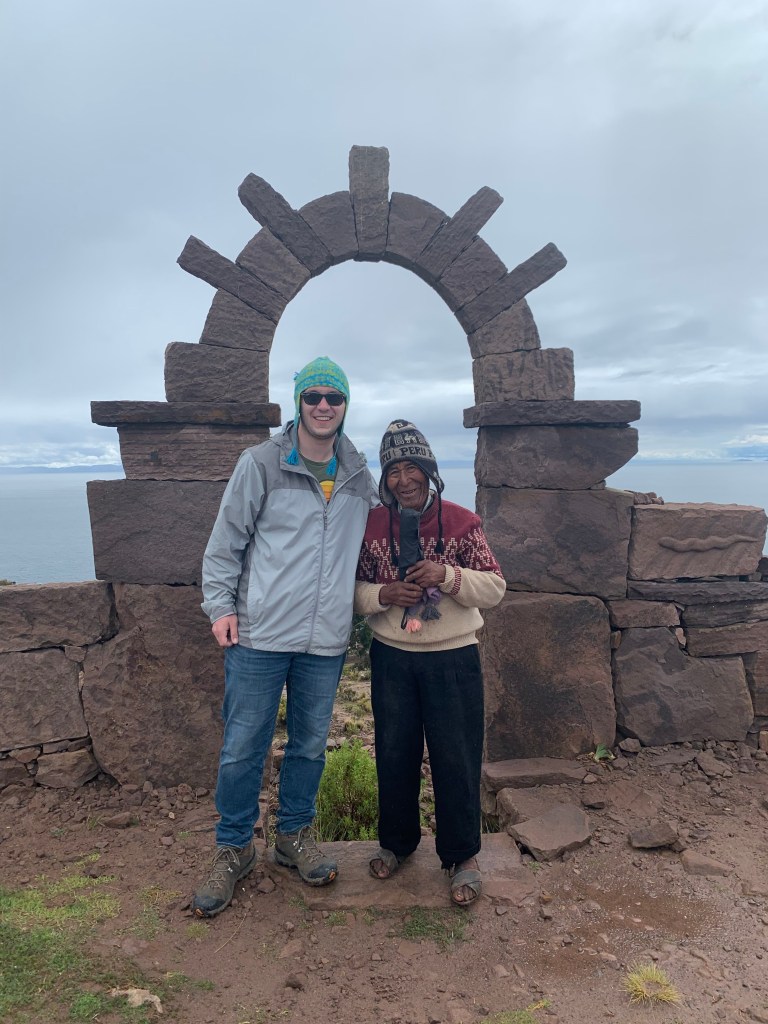
That day on Taquile is a day I will never forget, and every time I look at my chullo, I am reminded of the important lesson I learned simply through interacting with the Andean people and culture—in my case, through trade. Visiting Taquile allowed me to learn that in trade and exchange, there is a very important aspect of human connection that is not emphasized enough in our culture. With that being said, there are most definitely a multitude of other lessons we can learn from the diverse culture of Peru. On Taquile alone I was exposed to many new aspects of culture and ways of life which, while seemingly unusual to me at first, placed value or importance on aspects of life which I had never previously considered. For this reason, I am so grateful I had the opportunity to visit Taquile, and I would recommend a visit to Taquile or other islands of Lake Titicaca to anybody even remotely interested. The amount which can be learned about culture, way of life, and one’s self is unprecedented—even when it is about something as simple as a trade.
That trade, simple as it may have been, was my favorite moment of the trip. Now that I have returned to the states, it is constantly on my mind. Just a couple of days ago, I was walking home from class on what I had assumed would be a clear day when a sudden and heavy downpour struck. Out of habit, I reached for an umbrella in my backpack which was no longer there. Instead, I had to finish my walk home without it. As I continued walking through the pouring rain with wet socks, mud around the bottom of my jeans, and soaked clothes stuck to my skin, I could not help but smile and think about my trading partner on Taquile Island with his new umbrella.
 Indigenous Ways in Peru: Postcards from Students